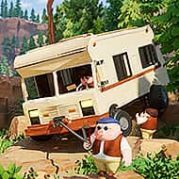







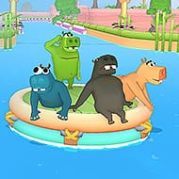
You let out a burst of gas half a second too early, and the whole boat lurches sideways into a wall while three friends shout your name at once. That moment is what Fart Together is built around, and it shows how a joke premise can hide a real coordination puzzle. The game puts one to four players in charge of a single boat, and every push anyone adds changes where everyone ends up.
| Genre | Physics-based parkour with shared steering |
| Players | 1–4, local couch co-op or remote co-op |
| Core mechanic | Steering one boat with fart power |
| Main challenge | Syncing direction, timing, and gas power |
The core idea is easy to explain and awkward to execute. Every player contributes gas power to the same boat, so there is no separate character to keep safe, only one hull that has to get through each obstacle course. Pushing harder does not fix anything. What matters is lining up direction, timing, and gas power so that everyone’s thrust adds together instead of cancelling out. A solo run teaches the basics, but the real lesson arrives when a second player joins and the boat suddenly has two opinions.
Early in the game, most groups treat the boat like a rocket and push all at once. The result is a spin nobody can explain afterward.
Physics-sandbox fans usually adapt fastest, because they already think in momentum and drift instead of raw speed. Short bursts followed by a pause to let the boat settle beat constant pushing in almost every situation. The parkour side of the game rewards patience far more than reflexes, which surprises people who expect a pure party mess.
The pitch behind the game says the secret is not farting harder but farting together at the right time, and that line holds up in practice. A stronger push at the wrong moment wastes momentum and throws the boat off the line you wanted. A weaker push that lands in sync with a teammate can carry the boat across a gap that looked impossible. Learning to wait for the right half second is the biggest skill jump you will make.
Groups tend to settle into informal roles without ever agreeing on them:
Couch groups on a single PC have an edge here, since a countdown works best when everyone hears it at the same instant. Friends playing remotely need voice chat to keep up, and without it the timing falls apart quickly.
Difficulty changes sharply as the player count climbs. One person controls every push and can predict how the boat will move. Four players each add their own thrust, and a small timing error from one of them spreads through the whole crew. Once a fourth player joins, the boat can feel like it has a mind of its own, and an obstacle course that took a few tries alone can swallow an entire evening.
That chaos is also the most divisive part of the game. The humor depends on a group that enjoys shouting and blaming each other, and a player who wants a calm, precise platformer will probably find the noise exhausting. Remote co-op needs a stable internet connection, which adds one more way for a session to go wrong.
Fart Together can point at whoever tipped the boat, though no scoreboard settles who started the argument afterward. That gap is where much of the fun lives, because the blame game after a failed run is half the reason groups keep saying one more try.
Yes, the game supports one to four players, so a solo run works. You handle direction, timing, and gas power yourself, which makes it the best place to learn how the boat drifts before friends start adding their own pushes.
It does. Couch co-op on a single PC sits alongside remote co-op, and the remote option needs a stable internet connection. Local groups often coordinate better because a spoken countdown reaches everyone at the same moment.
Use short bursts of gas power instead of long ones, and let the boat settle between pushes. Agree on one player to call the count, because a single mistimed push from a teammate is usually what flips the hull on an obstacle course.
Fart Together works best when a group stops shouting and starts counting. Once the boat settles, the gas power lands in rhythm, and the obstacle course finally gives way, the blame game turns into the one more try that keeps a whole evening going.