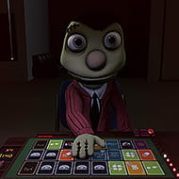
The choice between becoming a ringleader or staying a quiet honors student is the first real decision Camp Buddy hands you, and it has nothing to do with a camp. Underneath the listing sits a different game entirely — an anime-styled interactive fiction called School Life, built around a run of high school choices rather than anything resembling a summer camp.
| Actual title behind the embed | School Life |
| Format | Click-based branching interactive fiction |
| Setting | High school, told through either-or story choices |
| Core mechanic | Choices lock in a path; a redo option lets you retry with a different one |
Load the page and there’s no camp counselor, no cabin assignment, no map of activities — just a high schooler facing a string of pointed either-or moments, each one clicked through rather than played in real time. The framing text calls it a life “full of interesting events and trials,” and that’s a fair summary: this is closer to a choose-your-path story than a simulation with systems running underneath it.
Nothing about the actual game references camp buddies, camp grounds, or a summer setting of any kind. Anyone landing here expecting that will be reading a different game’s premise onto a high school story that never asked for one.
What it does deliver, consistently, is a sequence of forks where the game commits you to one path and lets the consequences of that path play out to their (sometimes bleak) conclusion before it lets you see the alternative.
The first major branch asks you to pick an identity outright: become the school’s ringleader, the kid other students orbit around, or settle into life as a quiet honors student who keeps their head down. Neither option is dressed up as the “correct” one — the game just commits and moves forward from whichever you pick, reshaping which later choices even show up.
Players expecting a hidden best path tend to be disappointed here. The ringleader route and the honors route aren’t graded against each other; they’re two separate stories the game is willing to tell depending on which door you walk through first.
That commitment is also the thing regular players bring up most when they discuss it — there’s no warning before the fork locks in, so a first click is effectively a first playthrough decision. By the time the disco-or-study choice shows up a few clicks later, whichever identity got picked first has already quietly changed which version of that later choice even appears.
Later choices stack on top of the first one. Skip class for a disco night, or stay home and study for an exam instead — a small decision that, combined with earlier ones, nudges the whole run toward one of two very different financial endings: ending up a millionaire, or ending up homeless. There’s no meter on screen tallying this in real time; the game just resolves it at the end based on the pattern of choices behind you.
That’s a blunt way to model consequence, and it’s exactly the kind of stakes-first structure that makes this game land better as a quick story than as something you’d expect deep systems from. Community discussion of it treats the millionaire-or-homeless split as the whole point, not a side detail.
Because the disco-versus-study choice reads so small in the moment, first-time players regularly under-value it, only realizing afterward how much it fed into where the run ended up.
If a run ends somewhere you don’t like, the game lets you go back in time and pick differently — a straightforward redo rather than a punishing permadeath structure. It’s convenient, and it’s also the game’s most divisive feature: undoing a bad ending on demand removes some of the weight the earlier choices were building toward.
Whether that trade-off is worth it depends on what someone wants from a ten-minute click-through story rather than a game meant to be replayed for mastery.
Three different players tend to land on this listing. One clicks through once, picks whatever feels right in the moment, and reads whichever ending they land on as the whole game. A second treats it as a completionist exercise, using the redo mechanic to run both the ringleader and honors-student branches back to back just to see how differently the same disco-or-study choice plays out. A third is the skeptical checker who came here specifically because the title and the content don’t match, and wants to know what’s actually behind the click before recommending it to anyone else.
For that third type: no, Camp Buddy is not a horror game or a camp sim under a different name — it’s School Life, and the honors-student path is not secretly the “true” ending, just one of two the game is equally willing to tell.
Picking a wrong choice doesn’t end the game early either; every fork resolves into an ending you can read through, then redo if you want a different one.
Whatever the listing implies, Camp Buddy is a short, blunt high school choice story where the ringleader-or-honors-student fork and the millionaire-or-homeless ending are the whole game, and School Life is the name worth remembering if you ever want to find it again on its own.