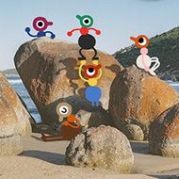
In Big Walk you start with a group of friends, one far-off landmark you all agree to head toward, and no waypoint, map marker or tutorial telling you how to reach it, which matters more than it sounds. Every decision after that, from which path to take to who carries the walkie-talkie, is something your group has to talk through, and talking turns out to be the hardest and funniest part of the whole trip.
| Genre |
Co-op exploration and puzzle adventure |
| Players |
2 to 12 |
| Communication |
Proximity voice chat and proximity text chat |
| Structure |
Hand-crafted adventure with a beginning, middle and end |
| Signature tools |
Walkie-talkies, laser pointers, binoculars, megaphones, flares |
The Landmark You Pick at the Start of Big Walk
The opening choice sets the rhythm for everything that follows. Once the group picks a distant landmark, you wander through woods and open ground, stumbling onto challenges, environmental puzzles and small escape rooms along the way. There is no objective marker pulling you forward, so conversations about direction happen naturally, and so do arguments. The world gives you room to stop, watch the day turn to night, or mess around with physics while the rest of the group debates the route.
It is a walk first and a puzzle game second, and that order is deliberate.
Your character is a round, brightly colored creature with stretchy limbs that can run, climb, slide, point and carry objects. That limited but expressive moveset is what makes physical comedy happen constantly. Groups looking for a relaxed social evening rather than a checklist tend to fall for the pacing immediately, because the game rewards hanging out as much as solving things.
Proximity Voice as the Real Puzzle Layer
Voice chat is spatial, and that single rule shapes every session. Your voice fades as friends move away, echoes in enclosed spaces and underground tunnels, sounds muffled behind walls and cuts out entirely once someone wanders too far. Text chat follows the exact same rules: messages become unreadable at long distances or across soundproof glass. That means players without a microphone can finish the whole adventure without missing the communication puzzles.
Many puzzles are built around this limitation. Some require the group to split up, observe different parts of the environment, or pass information between players who cannot see the same clue. The solution is rarely hard in itself; getting the information from one person to another is the actual challenge.
Walkie-Talkies, Megaphones and Soundproof Glass
Walkie-talkies are the bridge between separated players, and your voice crackles through them in a way that instantly sells the fantasy of a real hike. Radios are spread generously across the island because the game expects long-distance coordination regularly. The catch is that tools can be lost or broken, and a walkie-talkie dropped down a cliff is simply gone.
Every group has its own disaster story, usually involving the binoculars ending up in the ocean at the worst possible moment.
Tools That Turn Into Shared Vocabulary
The tool list reads like a scout troop that got lost in a prop warehouse. Each item changes how your group communicates, and several only make sense once somebody finds a use nobody expected.
- Walkie-talkies connect players who are far apart or separated by walls.
- Laser pointers let you point at something distant when words fail.
- Binoculars reveal details on landmarks that only one person can see at a time.
- Megaphones push your voice farther than normal speech reaches.
- Flares mark locations for the whole group, day or night.
- Whiteboards, cowbells and a big golden head round out the stranger end of the kit.
Because nothing is labeled, groups build their own vocabulary from scratch. The red, peanut-shaped pickups almost always end up being called “beans,” and the huge structures on the horizon get whatever nickname the loudest person invents first. That improvised language is a big part of why sessions feel personal.
When talking is not an option at all, your arms do the work. Pointing, waving and wild flailing become a real communication channel, and some of the best moments come from a friend frantically gesturing on the far side of soundproof glass.
Beans, Keys and the Parts of the Island You Unlock
Collecting enough beans earns keys, and keys unlock pieces of infrastructure scattered around the island: a toy-like train, bridges and entirely new areas. The loop is never formally explained, which fits the tone of the game. Most groups figure it out after the first key appears and someone asks what on earth it opens.
By the time you ride that train for the first time, the island feels much larger than it did at the start. Areas you stared at from across the water suddenly become reachable, and the group usually splits up again to explore them.
How Puzzles Change With Two, Three or Four-Plus Walkers
Puzzles adjust to the size of your session, with different setups for pairs, trios and larger groups. With two players the adventure feels focused and structured, almost like a co-op puzzle game with scenery. With four or more, the same areas turn into organized chaos as people drift off, start side projects and return with objects nobody asked for.
Puzzle-first players often prefer small groups for exactly that reason. Larger groups trade efficiency for stories, and both approaches are valid ways to play.
Group Size and the Chaos Ceiling in Big Walk
The game supports as many as 12 walkers, and the jump from four to twelve is enormous. Someone will vanish into the forest for an hour and come back holding a mysterious object. Someone else will accidentally sabotage a puzzle the rest of the group spent ages setting up. That unpredictability is exactly what many players love and exactly what drives others up the wall.
The most common criticism is the lack of direction. Goal-oriented players can feel adrift without markers or hints, and because there is no solo option, you always need at least one friend available. Crossplay across PC, PlayStation 5 and Nintendo Switch 2 helps assemble groups, but scheduling a full walk is still a real commitment.
For groups who embrace it, those same traits are the appeal. You cannot progress without each other, and nobody else can progress without you, which is a rare feeling in co-op games.
Questions New Groups Ask About Big Walk
- Can you play solo? No. The adventure needs at least two players and supports up to 12, because the puzzles depend on sharing information that one person alone cannot see or hear.
- Do you need a microphone? No. Text chat follows the same rules as voice, fading with distance, blocked by soundproof glass and passing through walkie-talkies, so keyboard-only players can finish the full walk.
- Is there an actual ending? Yes. The walk is a hand-crafted adventure with a beginning, middle and end, meant to be played start to finish with the same group while you unlock the train, bridges and new areas along the way.
Big Walk turns a simple idea into a genuinely social puzzle: pick a landmark, keep a walkie-talkie close, name the beans whatever you like, and figure out how to get one clue across a canyon of fading voices. Bring friends who like to talk, and try not to throw the binoculars into the sea.