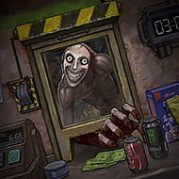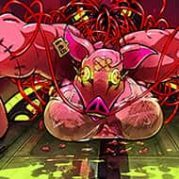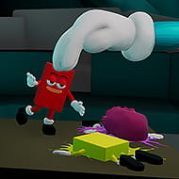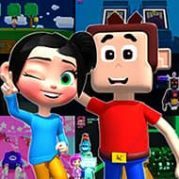
In Randy & Manilla you begin at home in Bloxland Qubitown, and the calm does not last, because a messenger program named E-Mailer turns up with bad news about the Net-Cubes. The setting is the year 2142, inside a quantum supercomputer whose digital worlds are under threat from Cracksom Virus, a corrupting villain who wants to wipe them out. From that first scene the game shows its main trick: instead of one long world, you travel between separate Net-Cubes that each play like a different kind of video game.
| Genre | Multi-genre 3D adventure |
| Heroes | Randy and Manilla |
| Scale | More than 40 levels across 9 Net-Cubes |
| Status | Early Access |
Between levels you do not pick from a plain menu. You pilot a ship across a map of floating Net-Cubes, and the center of that map is Quantum City, a giant cyan Net-Cube where E-Mailer and Blue Quantáramo live. A minimap helps you spot which cubes can be entered, and route lines and arrows point you toward your next destination.
The map works as an overworld and a level select at once, which gives travel a little personality. Some players admit that steering the ship around the cubes feels slightly confusing at first, so expect a few wrong turns.
With 9 Net-Cubes open in Early Access, learning which one leads to which style of play becomes part of the fun. Each cube hides Memory Qdatas, which are the collectibles that give the trip its sense of progress.
You can choose either hero, but the game does not treat them as interchangeable. Terra-Qubit is designed around Randy, while Wonder Race is a Net-Cube where only Manilla takes part, and it is the place where her abilities get the most room. Manilla’s involvement grows the further you travel, so players who begin with Randy will see her role expand.
Randy’s pace has drawn the most criticism. He can feel sluggish because of his animation, and both heroes can now sprint to make movement snappier.
The creator has also been candid that the 3D controls do not reach the polish of a Super Mario, which is worth knowing if you are a platformer purist. Smooth control is the goal, yet jumps and turns can still feel a little loose in tight sections.
Terra-Qubit is the platformer-flavored world, and its levels revolve around smashing bricks, collecting Net-Points, which appear as yellow cubes, and avoiding hopping blocks on the path. Infected terra-qubiters are the enemies to watch, and players mention using fireballs against them. Some objectives even involve corrupt bricks, so the level goals are not always obvious.
Beginners tend to grab every Net-Point in sight, which sounds sensible but backfires. One player admitted to ignoring out-of-the-way points after a third death because Randy was too slow to collect them comfortably, which is a fair trade-off in a timed section.
Players also discuss reaching certain point totals and clearing bricks quickly to open hidden barriers. That kind of hidden logic rewards repeat attempts, although it may frustrate anyone who prefers clear instructions.
The real draw is how different each cube feels from the last. Here are several Net-Cubes that players mention by name.
By the time you reach Gamezone Cube, you are reading arcade rules instead of platform layouts, and players who enjoy mini-games will find plenty to chew on. One group of testers was amazed by how many different mini-games they met along the way.
Dungeon fans should look to Rol & Rogue, while racing lovers will want to reach Wonder Race as soon as possible. The constant change is a strength, yet it also means no single mechanic gets fully mastered before the game moves on.
Completionists get a dedicated ranking screen. Open the pause menu, press the ranks button, and you will see a table of every level with its ranking system, which gives replaying a clear purpose.
Collected Memory Qdatas appear in the pause menu too, marked with Roman numerals that show the order in which you picked them up in each Net-Cube. It is a small touch, but it turns collecting into a trail you can look back on.
With more than 40 levels to revisit, chasing better ranks and hunting missed Qdatas gives the game a longer life than a single run suggests.
The sharpest complaint concerns world 5. One reviewer enjoyed everything up to that point, then described it as a trial-and-error time sink where one wrong move sends you back to the start of the level. Another forum topic exists solely to help players past level 5-4, which says plenty about where people get stuck.
The game is also still in Early Access, so sections can change, and the creators plan three big updates with new Net-Cubes and new mechanics. Only a small number of reviews exist so far, all positive, which means fewer guides and less certainty about later stages. Audio is fully in Spanish, with English subtitles.
A demo is available for anyone unsure about jumping between genres. If you like colorful, experimental adventures and do not mind rough edges, it is a sensible first step.
Randy & Manilla is at its best when a new Net-Cube changes the rules and pushes you to adapt, whether you are smashing bricks in Terra-Qubit, racing through Wonder Race or flying back to Quantum City for the next target. Collecting Qdatas and chasing ranks gives the journey structure, while Cracksom Virus keeps the stakes clear. It is an ambitious game that is still growing, and that ambition is what makes it worth watching.