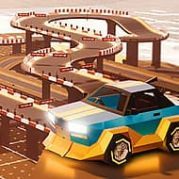
What happens when you can build a course block by block in Traks and send it to a friend as a plain text message? You get a physics-based racing game where the tracks matter as much as the cars, and where a layout you spent an evening on can reach a friend through any messaging app in seconds.
| Genre |
Physics-based racing with a block-based track editor |
| Modes |
Classic Race and Bunny Hunt |
| Players |
Single-player, local multiplayer and multiplayer across the internet |
| Opponents |
Up to 20 bots across four difficulty levels |
| Sharing |
Track codes sent through any messaging platform |
| Cars |
Tunable and customizable, with paint, spoilers and bumpers |
Building a Course Block by Block in Traks
The block-based track editor is the heart of Traks, and it is built to be quick rather than fussy. You place blocks in a linear building system with keyboard support for rapid construction, and you can click any placed block to modify it later. That last part matters more than it sounds, because it means a layout can be adjusted after a test lap instead of being rebuilt from scratch.
The editor offers four road types and four track scenes alongside a large set of block variants, so early in the game your first courses will probably look alike and only start to diverge once you learn the block set. The grid is described as massive, which suits builders who enjoy tinkering with long, layered layouts. The inspiration is openly retro, with 90s racers such as Stunts and Re-Volt behind the idea, and that lineage explains why building a course is treated as part of playing rather than a side feature.
The classic mistake is drawing a course that looks spectacular and drives badly. Drop a car on it right after each change, because a layout only proves itself at speed.
Sending Tracks as Text Codes and Racing Shared Courses
Sharing is where the design gets clever. A finished track exports as a simple text code, and anyone who receives it can import the layout, which means any messaging platform works as a delivery method. A friend pastes the code, loads your course and is racing your layout almost immediately, with no extra setup to walk them through.
Once both of you have the code, you can race the same layout side by side locally or against each other across the internet. Local and global leaderboards then turn a shared track into a small competition, which is where time-trial chasers will spend most of their evenings, shaving milliseconds off a lap.
There is one honest limit. Because tracks travel as text codes, finding good layouts in practice depends on players trading them in the community. Racers who prefer a big public catalog to browse may find that a slower way to build a library of courses.
Tuning FWD and RWD Cars in Traks
Cars in Traks are meant to be felt rather than merely driven, and tuning is how you make one yours. Visual options cover paint jobs, textures, spoilers and bumpers, while performance options reach steering angle, drivetrain and wheel types and sizes. That makes the FWD versus RWD choice a real handling decision instead of decoration, and it is the first thing worth experimenting with in a physics-based racing game.
The main menu doubles as a test track, so you can change a setting and see how the car reacts without loading a race. Beginners often skip that step and start a race on default settings, then wonder why the sharp turns of Lakehouse keep pushing them wide. A short test in the menu is the cheapest way to answer that question.
Seven tunable cars are available at the moment, which is enough to find a favorite but not enough to feel endless. Tuners who want deep variety should treat that roster as a starting point, since more cars and more customization options are part of the plan.
Lakehouse, Urban City and Western Canyons: The Premade Tracks
Lakehouse is a technical lakeside forest track packed with sharp turns, and it is where weak tuning shows up fastest. Professional Racetrack is the classic circuit, the place to learn braking points and to see how your drivetrain choice behaves on clean, predictable curves.
Urban City carves through several districts, past skyscrapers and a massive docked ship, and it rewards racers who read the road a few seconds ahead. Space Track is the odd one out, an otherworldly circuit built around defying gravity, which makes it a real change of pace from the grounded circuits.
Western Canyons is a canyon circuit with a steam train, an ancient village and a mystical cavern, and by the time you reach it the variety of the roster is obvious. The honest limit is size: the premade selection is small for now, so racers who want a large campaign will lean on the editor and shared codes instead.
Bunny Hunt and Bot Races in Traks
Classic Race is pure speed, while Bunny Hunt asks you to explore each track and find 10 hidden bunnies to unlock exclusive customization options. It is the mode that makes you look at the scenery instead of the racing line, and it is a clever way to reuse the same courses without repeating the same lap.
Bots fill the grid when friends are not around, with up to 20 opponents across four difficulty levels: Easy, Normal, Hard and Extreme. Newcomers should start on Easy and work upward, while veterans of Re-Volt-style racing can jump straight to Extreme for a proper fight. Bots are also the easiest way to test a freshly built course before you send its code to anyone.
Local multiplayer is supported for face-to-face races, and split-screen is still listed as in development, so anyone planning a couch session should check how that feature stands. Text chat and proximity voice chat are part of multiplayer across the internet, which keeps races social, and the game also supports Oculus Rift headsets for racers who want VR.
Traks works best when you treat the editor, the text code and the tuning menu as one loop: build a course, send it to a friend, and see who finds the tenth bunny in Bunny Hunt or wins the first lap of Lakehouse.