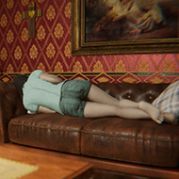
In That’s Not My Mom! you start as an elementary school boy walking back into his own house after school, and that everyday return is the entire setup. Mom is there, the rooms look familiar, and your job is to notice what has changed. Each trip home can hide anomalies, and the whole anomaly-finding structure depends on how well you remember what normal looked like.
| Genre | Anomaly-finding psychological horror |
| Platform | PC |
| Perspective | First-person |
| Setting | The boy’s house after school |
| Inspiration | Exit 8-style anomaly loops |
The core mechanic is observation. Every return home is a new check: walk through the rooms, look at the furniture, the walls and Mom herself, and decide whether anything is off. Some anomalies are obvious, while others are tiny shifts that most players only catch after they fail and replay the same loop.
Anyone who has played Exit 8 or Twisted Gallery will feel at home right away, but the house setting makes the changes feel more personal. It is harder to stay calm when the anomaly is your own mother’s behavior rather than a poster in a hallway.
The biggest beginner mistake is walking too fast. Players who memorize the first clean version of the house slowly and carefully spot small changes far more reliably than those trying to rush to the end.
Mom is the center of the dread. Early on she only acts slightly suspicious, but as loops continue her presence becomes the anomaly players watch most closely. The story hints that strange events are spreading beyond the house into the city, and uncovering the truth behind this anomaly outbreak is the long-term goal.
The silence does most of the work, and several players say it scared them more than any sound effect.
Observant players who enjoy puzzle games get the most out of it, because the scares are a reward for noticing rather than a surprise dropped on you at random. Horror fans who want constant chases may find the pace too quiet.
The anomalies worth training your eye on are rarely dramatic. A picture frame hanging at a slightly different angle, a door left open that was closed on the last visit or Mom standing in a spot she never used before can all be the difference between moving forward and repeating the loop. Players who clear it fastest usually say they stopped looking for scares and started looking for mistakes in the room.
Early loops are forgiving, with changes that stand out once you know where to look. By the time Mom’s behavior itself becomes the anomaly, the differences get subtle enough that many players admit they missed a detail they were sure was normal.
Streamers get a lot of mileage from this, because chat often spots the change before they do, turning each loop into a shared hunt through the same few rooms. It is one of the few horror games where an audience actively helps.
Consistency beats instinct here. A reliable routine makes every loop easier:
Performance is the most common complaint. Some players report the game feeling sluggish even on high-refresh setups, which can make careful scanning more tiring than it should be. The visuals are intentionally modest, so lowering settings rarely hurts the atmosphere.
That’s Not My Mom! turns a boy’s walk home from school into a test of memory, where the living room, the kitchen and Mom herself are the puzzle pieces. Learn the clean version of the house, watch Mom closely on every loop, and the anomaly outbreak slowly reveals what really waits behind the front door.