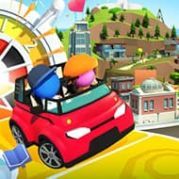
You land on a crossroads in The Game of Life 2, the spinner still ticking down from your last turn, and the next tap decides whether you head to college or take a paycheck right now. Nothing looks dangerous on the bright 3D board, yet that one choice shapes everything that follows, from your salary to your house to how you retire.
Every turn starts with the spinner. You spin, your peg moves along the Life Path, and the space you land on triggers an event such as collecting a salary, buying a house or drawing an Action card. Crossroads spaces are where the real decisions sit, because they force a branch instead of a straight walk. Up to four players can take turns on the Classic World board.
You pick a pink, blue or purple peg at the start of each game, and the avatar, outfit and vehicle unlocks add personality on top. The base game begins with 3 outfits, 3 avatars and 2 vehicles ready to use, and holds back the same number of each as rewards. Completionists tend to stay for exactly that kind of unlock list.
The spin itself is pure luck, and that half second as the spinner slows near an edge is the tensest moment on the whole board.
Money is no longer the only way to win. The final score sums three attributes, and a life built on any one of them can come out on top, as can a healthy mix of all three. Side goals feed the same loop, since collecting 60 happiness points or traveling 100 spaces each unlocks a puzzle piece.
Wealth is the traditional route: salaries, a bigger house, a career change that pays more. Money-first players like it because the path is easy to read.
Knowledge rewards choices like going to college early. It suits planners who would rather invest first and cash out later.
Happiness grows through relationships, kids, pets and the lighter events along the way. Pet lovers and family-minded players usually drift here without even planning it.
Early in the game you face the first big question, college immediately or straight into a career. Beginners almost always grab the paycheck because it feels like progress, then discover at the end that the Knowledge column sits empty. Strategy-minded players tend to sketch the whole route from the first crossroads instead.
The second beginner trap is ignoring Happiness until the late board. Kids and pets are choices rather than obligations, and skipping them entirely only works if your Wealth is carrying the whole score. Marriage, a house and a career change are all optional too, which is why two lives on the same board rarely look alike.
By the time you reach later crossroads, the foundation you built matters more than any single spin. A balanced life is usually more forgiving of a bad spin than a one-track one, so the early turns reward patience over speed.
Beyond the Classic World, the sequel layers themed boards on top of the same rules. Fairytale Kingdom sends you on an enchanted quest, Haunted Hills turns you into a Monster Herder, Frozen Lands brings its own magic, and Age of Giants gives dinosaur fans their moment. Sandy Shores and Sweet Haven round out a long list, and the Ultimate Life Collection bundles 8 worlds together.
What comes included depends on where you buy. Console listings present Fairytale Kingdom and Haunted Hills alongside the base game, while PC storefronts list them as add-ons. Check the store page before assuming which worlds you own.
Because worlds are sold separately on some platforms, players debate whether they are worth the extra spend. The Classic World already covers the full loop of spinning, choosing and retiring, so the themed boards read as variety rather than a requirement.
The earlier app was built around a race to the final yellow square, with matchmaking, minigames and a fast mode. The sequel shifts the weight onto choices, so reaching the end of the board matters less than what your Wealth, Knowledge and Happiness add up to. Players who loved the old finish line sometimes miss that clean race.
Retirement is the next argument. You can retire to a luxury home or keep going, and big career, relationship and financial choices can come early or late. Cautious players lock in a lead, while risk-takers keep spinning for one more salary or one more pet.
The other honest split is luck. The spinner decides how far you move, and critic scores for the sequel sit in the middling range even while player ratings run warmer. Treat it as a relaxed family game with a few real decisions, and it delivers. Expect deep strategy, and the spinner will remind you who is in charge.
The Game of Life 2 works because every spin, from the first Classic World crossroads to a Fairytale Kingdom quest or a retirement in a luxury home, forces a trade between Wealth, Knowledge and Happiness. Decide what kind of life you want before the next crossroads, because the spinner will not decide it for you.