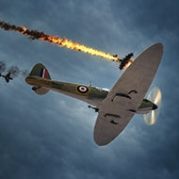
What do you actually do when a Bf 109 slides onto your tail at low speed and the Hurricane under you is already going mushy on the stick? Sky On Fire: 1940 puts that question to you within the first few missions, and the answer depends on physics that look nothing like the low-poly graphics suggest.
| Genre | WW2 flight simulation |
| Platforms | PC and mobile |
| Period | Battle of France to the Battle of Britain |
| Playable nations | Germany, France, England, Italy |
| Aircraft | More than two dozen |
| Main modes | Short Missions, Mission Editor |
| Extras | Multicrew, photo mode |
The first thing players notice is the look: chunky, low-poly planes and landscapes that seem to promise arcade fun. The second thing is that the aircraft follow airfoil-based physics, so lift, stall and energy all matter. A pilot who hauls the stick back in a tight turn at low speed will bleed airspeed and fall out of the sky. The sim has built its reputation in the mobile community on flight behavior, not on graphics.
Beginners usually make one mistake, which is flying like it is an arcade shooter. A few habits help during the early sorties:
Players who like energy tactics talk about boom and zoom, which means diving on a target, firing one pass and climbing away instead of getting dragged into a turn fight. Once you stop chasing the enemy around the sky and start choosing when to engage, the game opens up. Dying while someone sits on your six is part of the learning process.
The Spitfire is the poster plane, remembered for tight turns and responsive handling, while the Hurricane is remembered as the sturdier and more forgiving of the pair. New pilots often start with one of these two because they teach the basics without punishing every small error. Flying both back to back is the quickest way to feel how different two fighters from the same side can be.
The Defiant is the odd one out. Historically it carried a turret instead of forward-firing guns, so you cannot treat it like a standard fighter. Flying it forces you to rethink positioning, since your firepower sits behind the cockpit rather than in front of it.
Once the missions shift to the Battle of Britain, the RAF side is largely about intercepting raids. Positioning above the escorts matters more than raw turning ability, and the best results come from picking a bomber, making a clean pass and getting out before the escorts react.
Switching to Germany flips the logic of the sorties. The Bf 109 is the natural boom and zoom machine, with a climb and dive that reward patience over pursuit. The Bf 110 is a heavier twin-engine fighter, so most players treat it as a hit-and-run aircraft rather than a dogfighter.
The Ju 87, known to everyone in the community as the Stuka, is a dive bomber that you fly to hit ground targets, and it is painfully vulnerable once enemy fighters arrive. The Ju 88 and He 111 are bombers where you plan the run first and worry about defense second. Players who enjoy methodical, mission-focused flying tend to gravitate to these.
France and Italy round out the four playable nations, so the roster is not just a Spitfire versus Bf 109 rematch. Each side changes the tone of a sortie, and switching nations is a good way to keep the game fresh after you have mastered one cockpit.
The primary mode is Short Missions, quick sorties sorted into four categories. They are straightforward by design, and the game sits closer to a lighter sim than to a full-fidelity study sim. Do not expect a hundred-switch cockpit, but do expect a plane that will punish sloppy handling.
Players who want large-scale battles build them in the Mission Editor. You can set up a 1v1 duel or a huge battle with dozens of aircraft, which makes it the real long-term mode. Creative players will spend more time here than in the premade sorties, since the editor lets you test any matchup you can imagine.
Not everything is polished. The AI is challenging, which some players love and others find punishing, and because one person is behind the project, the rough edges show in places. Players also debate the controls, particularly on touchscreens, and the low-poly look divides people who expect serious physics to come with serious graphics.
Multicrew lets you control each crew member in your aircraft. You can hand the stick to the AI and light up enemies on your six with a rear gun, which is a very different job from flying the plane. It changes how the bombers feel, and the Defiant becomes far more interesting when you can man the turret yourself.
Handing control to the AI feels odd at first, because you are used to being the only pilot. Give it a few sorties, though, and swapping between pilot and gunner starts to feel like a natural rhythm. Gunnery players will love the rear gun, since tracking a fighter through a turn is a skill of its own.
Photo mode and a camera you can move anywhere let you frame the best moments of a dogfight, and the community shares liveries and mods. The official Discord server has more than 10,000 members, so questions about controls or custom content rarely go unanswered.
Sky On Fire: 1940 rewards pilots who respect energy and punishes those who fly on instinct. Whether you are diving a Bf 109 out of the sun, holding a Hurricane steady through a bomber raid or manning the Defiant’s turret, the sim keeps asking you to think about speed before you think about guns.