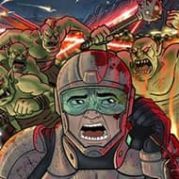
You drop a Cannon at the mouth of a long corridor, nudge its sweep arc a few degrees to the left, and press start. Within seconds the orcs pour across the map like spilled water, and your lone turret is already falling behind. Sir, We Have an Orc Problem is built around exactly this moment of cheerful helplessness, where tens of thousands of green bodies march toward your base and every run teaches you where your firepower should have been. It is a short tower defense game with an upgrade tree attached, and most players settle into its rhythm within two or three attempts.
| Genre | Tower defense with incremental-style progression |
| Platform | PC |
| Core Loop | Place turrets, survive the horde, spend crystals on the upgrade tree |
| Active Abilities | Strafing Run, Orbital Laser, Nuke |
| Typical Length | Around 4 to 6 hours, according to player reports |
The first thing you learn is that turrets do not simply shoot whatever is closest. Each one sweeps across an arc, and where you place it and how you angle that sweep decides how many orcs ever enter its range. Early in the game the maps are forgiving enough that a few Gunners in the middle of a route will carry you, which is exactly why beginners assume placement hardly matters.
The classic mistake is clustering everything near the base. That feels safe, but it means the orcs are already at the exit by the time most turrets fire. A better habit is to cover the long stretches of a route so the horde is under fire from the moment it spawns, then let your last turrets clean up whatever slips through. Veteran tower defense players will call this front-loading, but the sheer orc count makes the mistake louder here than in most games.
Walls matter too. A Laser bounces its beam off them, so the right corridor gives you coverage that a plain sweep arc would never reach.
Every run pays out crystals, whether you hold the line or get flattened. That single design choice changes how the whole game feels, because a failed attempt is never wasted. You carry those crystals into the upgrade tree, unlock new turrets, and buy stat boosts and perks such as Rapid Fire and Power Shot before trying the same level again. Incremental fans will feel at home immediately, since the loop is simple: fail, upgrade, return stronger.
The trap is spending crystals on cheap stat bumps while ignoring anything that adds another turret. Community guides keep repeating that tower count beats small percentage gains, and it is easy to see why once several routes open on one map. Chasing a perfect clear, a run where nothing reaches the exit, also pays out more than a bare survive, so the level menu quietly rewards precision.
When multiple lanes collapse before the horde reaches full strength, the problem is usually not your layout but a lagging upgrade tree. Replaying an earlier level to farm crystals is not glamorous, and players call it the grind. It is also the part of the loop that divides opinion the most.
The highest damage number on the stats screen rarely tells you which turret to buy. Each turret does a specific job, and the useful question is which route is currently leaking.
Laser is the turret players argue about most. A well-angled Laser solves wall geometry beautifully, but a poorly placed one can farm huge damage on a route that was already safe, so the number on screen looks impressive while another lane quietly breaks.
A single turret with enormous damage that still loses the run is the classic symptom of a coverage problem. When you see it, move the turret or add one to the neglected route before spending another crystal.
Active abilities are what turn a collapsing lane into a highlight. Strafing Run puts pressure on a wide stretch of route, so it works best when a long section is packed with orcs rather than as a patch over a lane with no turret coverage. Orbital Laser delivers sustained beam damage, which pays off when the horde stays inside a predictable line long enough for the beam to matter.
The Nuke is the emergency button, and the detail you only learn by playing is that it takes visible time to land. Fire it late in a wave and the blast arrives after the dense cluster has already moved on. Players who save it for one heavy breakthrough get far more value, and the Overkill achievement, which asks for 666K damage from a single Nuke, shows how much a well-timed blast can be worth.
Watching the horde’s path for a few seconds before you fire is the habit that separates calm runs from frantic ones. By the time you reach Levels 6.1 and 6.2, that habit stops being optional.
Length and price are the two complaints that come up most. Players commonly report roughly 4 to 6 hours of play across about 10 to 12 levels, and some feel that is thin for the asking price. Others consider the same hours great value, because the horde fantasy lands from the very first run.
Presentation is the other talking point. The visuals are plain, and the appeal comes from watching orcs flow across the map almost like a fluid while your numbers climb. Players who want more ask for a level editor, and some feel the crystal grind slows momentum once the tree gets expensive.
Casual players like it as a low-focus session they can run in the background, while tower defense purists are the ones most likely to push for deeper systems. Both groups tend to agree on one thing: the moment a perfectly angled Cannon shreds a packed corridor is deeply satisfying.
There is no single winner, but the Cannon is a safe early pick because its penetrating shots hit several orcs at once, and the Flamethrower covers tight corridors well. Add a second turret for another route before stacking stat upgrades, since tower count usually matters more than small bonuses.
Players commonly report around 4 to 6 hours across roughly 10 to 12 levels. Farming crystals on earlier levels to fill out the upgrade tree can stretch that, and chasing a perfect clear on every level or the Overkill achievement adds more time on top.
Fire it when a dense cluster of orcs is heading toward a predictable chokepoint, not when it is already there, because the blast needs visible travel time to land. Keep Strafing Run for long stretches of route and Orbital Laser for lines the horde will stay inside.
Sir, We Have an Orc Problem rewards the player who watches where the horde bunches up and puts a Cannon, a bounced Laser or a well-timed Nuke exactly there. Losing a run still feeds crystals into your upgrade tree, so every failed attempt is a rough draft of a better layout. Start with the corridor that keeps leaking orcs, fix that first, and the rest of the map tends to follow.