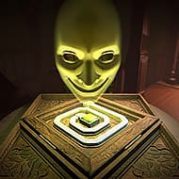
You roll the six-sided movement die in the game room, the token slides forward, and a rhyme above the board announces that the manor has just gained a Mummy that will stay for the rest of the run. That is the first lesson of Invokyr: every roll changes the house around you, and nothing you summon ever leaves. Up to six players share one cursed 1970s board, one dark manor, and one very talkative Gamemaster.
| Genre |
Co-op survival horror built on board game rules |
| Players |
1 to 6 |
| Setting |
A haunted manor and a cursed 1970s board |
| Goal |
Reach the center of the board and seal the Gamemaster’s soul inside it |
| Threats |
More than 15 monsters and more than 20 events |
| Themes |
Classic Board Games, Jungle, Icy Mountain, Desert |
How the Token, the Rhyme and the Loop Work in Invokyr
The structure repeats until the board is finished. One token stands in for the whole group, and a six-sided movement die pushes it toward the center. When it stops, a rhyme above the board names the event, the manor rearranges its rooms, and a new threat joins the house for good. You then hunt for idols, carry them to the game room, unlock the next movement die, and roll again.
This feels different from most co-op horror. Instead of one long chase, the game is a series of short expeditions with a safe room at each end. A few rolls in, the manor holds several monsters you have to keep in your head, and your route to the idols becomes a puzzle.
Tabletop fans will recognize the pacing of roll, react and regroup. People who want constant action may find the trips back slower, though the monsters you have collected keep each return tense.
Reading the Rhyme Before Every Move
Rhymes are your only warning, and they announce a monster spawn, a minigame or a platforming challenge. Monster rhymes are surprisingly literal. A verse about red light and green light means Dress Mannequins, a line about hearing everything means the Huntsman, and gathering copies means Snowmen. Read each rhyme twice before deciding who goes where.
Minigames drop the whole group into a short trial. The Trapdoor Game uses a 5×5 grid of symbol tiles, with a wheel choosing the safe symbol across three rounds. In The Floor is Lava, you stack 10 boxes in a 1-2-3-4 formation to reach the balcony before the lava rises. Others include the Chessboard, the Fire Pillar and the Ballerina.
The Shell Game punishes guessing. Three doors sit under shuffling cards, only one card shows the idol, and the other two doors are Mimic Door monsters. Dice Spawn is the opposite: it counts as the dice being rolled, so help and harm can land together.
Idols: Bronze, Silver and Gold
Idols are the economy of every run. Bronze, Silver and Gold idols are worth $100, $150 and $200, and turning them in unlocks the next movement die. The board shows how many it needs floating above it, so look up before leaving. Extra turn-ins keep producing movement dice, up to three, which helps when you are stuck with a cursed die.
Each idol also has an effect while held. Bronze idols are mild, like the Ice Idol that makes everyone nearby slide. Silver idols carry real downsides: the Music Box Idol spikes the holder for 20 HP, the Teleport Idol throws you somewhere random, and the Mirror Controls Idol reverses WASD and the mouse. The only gold idol logged so far is the Storm Idol, which keeps dropping lightning around you.
Idols look different, but you cannot tell what one does until you pick it up, and guide writers call that one of the rougher edges.
- Drop an idol and its effect stops at once.
- The Spider Idol runs off through the manor, so you have to chase it down.
- The Teleport Idol can double as an emergency escape.
Dice That Save Runs and Dice That Ruin Them
Dice are how you even the odds. Every die has a 5 in 6 chance of a Good Roll and a 1 in 6 chance of a Bad Roll, and many Bad Rolls trigger chaos such as lightning, fireworks or a minor monster. The Heal Die restores 50 HP to anyone in its area and revives the dead with 10 HP. The Resurrect Die brings back a random dead player, and if you die holding one it is consumed and revives you instantly.
Utility dice decide whether you get lost. The Scanner Die highlights idols, players and monsters in green through walls, and the Thread Die rolls a ball of thread toward the game room, which is priceless in the final trial. The Rally Die gathers every player in one spot, while a Bad Roll on the Teleport Die spawns a Dress Mannequin or a Penguin.
The Fire Die and the Storm Die can hurt monsters, and their Bad Rolls remove the usual delay, which some players find works in their favor. The Freeze Die immobilizes a target and the Cocoon Die wraps everything in a radius.
Monsters Worth Respecting in Invokyr
Every board has one guaranteed first monster, and the roster grows from there. The Dress Mannequin only moves when nobody is looking at it, and contact means instant death, so one teammate keeps eyes on it while the others pass. The Mummy trails a long bandage, and stepping on it sends the Mummy sprinting toward you. Standing on a table or box keeps you out of range of its sword.
Sound-driven threats punish loud players. The Huntsman hears even crouch-walking and hits for 70, and he is immune to fire. The Sandworm rumbles under the floor before lunging for 70, and the Alligator hits for 60 and also ignores fire.
Some monsters are puzzles. The Shadow Man crawls out of televisions playing static, and switching off the active television makes him vanish for a while. All Snowmen but one are harmless, and a thrown object pops the copies. The Penguin explodes for 100, and the Player Mimic repeats phrases from proximity voice chat, which makes talking to your team feel risky.
Shop Priorities Between Boards in Invokyr
The shop opens after the first board clear and again after each one, and every item has a chance to appear 30 percent cheaper. Upgrades last only for the current run, and their prices climb after each board. Health adds 25 maximum HP and stacks 8 times, Speed stacks 5 times, and the Fanny Pack adds an inventory slot twice at most. The Milk Bottle is a single-use full heal for 100.
The Old Clock is the standout piece at 2000. Once repaired, it sends you back to the shop after a total team wipe instead of ending the run. The Compass points toward the game room for 1250, and the Hunter Gun and Flamethrower cost 2500 each, with ammo that refills between boards.
Spare dice can be burned in the Dice Burner for $35 each, though dispenser dice cannot. Mirrors in the manor act as one-time save points. A sensible order is the Old Clock first, a Milk Bottle or two next, and cosmetics last.
The Final Trial and the Gamemaster’s Soul
When the token reaches the center of the board, the endgame fires automatically. Every dead player revives, and the whole group is teleported to a room deep inside the manor holding the Gamemaster’s soul idol. Your job is to carry it back to the game room, and that trip is the real test of the run.
This is where the Thread Die earns its keep, since you land in a part of the manor you have probably never seen. The soul idol has no held effect, so the danger comes entirely from the monsters collected over the run, and losing the carrier is what usually stalls the ending.
Once the idol is back, seal it into the board and say the name of the game into the microphone to finish the session. It is a small step that is easy to forget, and the run does not count until you do it.
Questions Players Ask About Invokyr
- Can you play alone or only with a full group? The game lists single-player support, so you can roll the movement die and collect idols by yourself. Heal Dice and Resurrect Dice matter less without teammates, but the monsters and idol rules stay the same.
- What happens if the whole team dies? Without the Old Clock the run ends. With the Old Clock repaired, you return to the shop instead, and a Resurrect Die or a mirror save point can prevent the wipe in the first place.
- How do you find the way back to the game room? The Thread Die rolls a ball of thread toward it, the Compass always points to it, and a Lantern Die can be dropped as a marker. During the final trial, the Thread Die is the safest choice.
Invokyr works best when your group treats the Old Clock, the Thread Die and the Dress Mannequin as real planning problems instead of random chaos. Each roll adds something permanent to the manor, and the fun comes from deciding which risk the Gamemaster has earned a reaction to next.