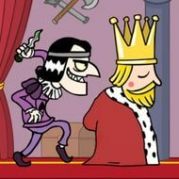
The king ages a little more every time he survives a check behind him. That single detail is what makes Murder more than a one-button gimmick — the role you’re playing right now was the role someone else was just playing against you a minute ago, and the game never lets you forget it.
| Genre |
One-button role-reversal skill game |
| Roles |
Assassin (attacking the king) and King (defending the crown) |
| Controls |
Spacebar only, held or tapped depending on role |
Playing The Assassin In Murder
As the assassin, the whole encounter boils down to one held key. Holding the spacebar raises a knife behind the king as he walks a long corridor; releasing it drives the strike down. Time it against a guard’s glance or the king’s own posture and the crown changes hands. Time it wrong and guards drag the assassin off to the dungeon, restarting the cycle with a fresh assassin and no memory of the failed attempt carried forward.
New players tend to strike the instant an opening looks plausible, without reading the king’s behavior first. Patient players who wait for a genuine lapse — rather than swinging on the first opportunity — end up succeeding far more often, since the king’s attention isn’t static throughout the walk.
Playing The King In Murder And Watching Your Own Back
Winning as the assassin flips the entire game state: the successful killer inherits the throne and immediately becomes the target of the next assassin in line. As king, the same spacebar now controls a glance backward, catching a would-be killer mid-strike or forcing them to abort and cover their tracks. A charge-up bar that used to represent an assassin’s readiness now counts down the king’s own remaining time on the throne — when it empties, the king simply dies of age, the crown passes on, and the whole cycle restarts with someone new stepping into the assassin role.
This is where Murder becomes something more than its slapstick premise suggests. Every skill a player picked up while holding the knife carries over directly to reading the same tells from the other side, and the game trusts that transferred knowledge instead of teaching the king role separately.
- What happens if the assassin is caught mid-strike in Murder? Guards pull the failed assassin away to the dungeon, and the cycle restarts with a new assassin — there’s no persistent penalty carried into the next attempt.
- Does the king ever actually win permanently? No — the aging bar guarantees every king’s reign ends eventually, either from a successful assassination or from the timer running out and triggering a natural death.
- Is there any weapon variety beyond the knife? The core loop stays built around the single knife-and-glance exchange; the tension comes from timing and role-reversal rather than equipment choice.
What Makes The Loop Worth Repeating
The corridor itself never changes, and neither does the basic exchange of holding, releasing, and glancing back — what changes is the player’s own read on tension, since every round either ends in a successful strike, a failed one, or a king’s natural death from old age. That last outcome catches most first-time players off guard, since nothing in the opening minutes signals that simply outlasting an assassin is itself a losing condition for the king.
Community discussion around Murder tends to circle back to that aging mechanic specifically — it’s the detail that turns what looks like disposable browser-game humor into something closer to a small, bleak thesis about power always changing hands one way or another, whether by knife or by time.
Murder works because it commits fully to its own premise: nobody holds the crown for long, every assassin eventually becomes a king, and every king eventually becomes someone’s target, all through the same held-and-released spacebar that started the whole cycle.