










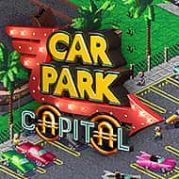
You buy a block of quiet houses, demolish them and watch the first cars pull into a fresh car park while a handful of pedestrians stare. That is the opening move of Car Park Capital, a satirical strategy and management simulation where you play a contractor hired to make a walkable town as car-dependent as possible.
| Genre | Satirical strategy and management simulation |
| Your role | Contractor hired by Big Auto |
| Core loop | Buy land, demolish homes, build car parks, drill for oil, manufacture cars |
| Pressure | Public opinion and anti-car protests |
| Extras | Level editor, Early Access |
The premise is delightfully backwards. You have been hired by Big Auto to bring car dependency to towns that, through an unfortunate historical oversight, still contain homes, trees, pedestrians and public transportation. Your job is to buy land, demolish homes and build vast parking facilities, until the town can no longer function without a car.
Parking is both the product and the pitch.
Behind the satire, the game is a real-time management simulation where hundreds of citizens and vehicles interact across interconnected systems of traffic, production, needs, public opinion and profitability. Early in the game you build your city from zero, and every decision ripples through those systems. A new car park attracts cars, but it also changes how people behave, which means the town you start with is not the town you end with.
Propaganda is your most important tool. You spread glossy pro-car messaging to convince townsfolk that driving is the only sensible choice, turning ordinary residents into what the game cheerfully calls carbrains. The more people who believe it, the more demand you create for the product you are selling.
Not everyone buys it. Some residents see through your oily business, and once the first protests appear, you have to control the anti-petrol crowd before they shatter your reputation. That makes public opinion a resource you manage as carefully as money, and it adds pressure to every expansion.
The satire is sharp, and it will not land with everyone. Players interested in urbanism will recognize the real-world arguments behind it, while those who just want a tycoon game can enjoy the numbers without the commentary. Some may find the joke wears thin over a long session, but the management underneath keeps it moving.
The core loop covers more than parking. A typical expansion looks like this:
The satire mirrors the induced demand loop urbanists describe: build for cars, and more cars arrive. By the time oil drilling starts running, you are managing supply as well as demand, and the production chain becomes its own puzzle. Each piece feeds the next, so a weak link, like too little oil or too few cars, drags down profit.
Tycoon veterans will enjoy tuning the chain for maximum profit, while players who like stacking and layering will appreciate the elevators and vertical car parks that appear as the city grows. The citizens’ needs get stranger as the town gets denser, and that escalation keeps the loop from feeling repetitive.
The look is colorful, isometric and pixel-based, with a retro 1990s feel that recalls RollerCoaster Tycoon and Transport Tycoon. For anyone who grew up on those classics, the visuals are half the appeal, and the joke lands harder because the format is so familiar. The difference is that this game asks what happens when a tycoon empire is bad for everyone else.
A level editor is included, which suits the sandbox-heavy construction side of the game. Steam Workshop support is something the team hopes to add if there is enough demand, so shared creations may arrive later. Players who like building scenarios will have something to do beyond the main game.
The honest caveat is that the game is in Early Access, so content is still growing on the path to 1.0, and feedback is gathered through Discord and Steam Forums. Early reviews on Steam are overwhelmingly positive across hundreds of reviews, but anyone who wants a finished product may prefer to wait. If you enjoy watching a game evolve with its community, the timing is part of the fun.
Car Park Capital asks you to solve every urban problem with more parking, and it makes the joke work by backing it with real systems: Big Auto’s brief, propaganda that creates carbrains, and protests that threaten your reputation. If you want a tycoon game that doubles as a sharp joke about car dependency, this one is worth your attention.