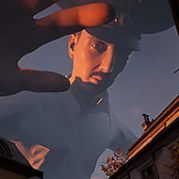
You grab your bag in a panic, still reeling from an accusation for a crime you never committed, and step onto a street where a policeman taller than the buildings is already looking your way. That is the opening moment of Militsioner, a surreal first-person immersive sim set in a clockwork town where every escape plan has to survive the attention of one colossal officer. The goal sounds simple: leave. Getting there is the hard part.
| Genre | Surreal first-person immersive sim |
| Goal | Escape the town |
| Main route out | The cable car |
| Pace | Slow, observant, reactive |
Early in the game, the smartest move is often to stand still and watch. The townsfolk follow daily routines, and their mood shifts depending on how you treat them, so the same person can be a helpful ally in one moment and a closed door in the next. Treat the first few minutes as reconnaissance rather than a sprint, and the layout of the town starts to make sense.
Beginners usually make the same mistake: they spot the exit and run for it. Every theft, act of vandalism, or bout of general menace-making gets noticed, and the Militsioner closes distance faster than any shortcut you have found. Stealth-minded players tend to settle into this rhythm quickly, because watching patterns is half of the job.
Knowing who stands where, and when, is the first real puzzle.
The Militsioner is not a boss you fight and not a timer you outrun. He reacts to what you do, so a disturbance or an illegal act in the street draws him toward you, and every action becomes a small gamble. The sense of being permanently watched is the entire point of the game, and it never really switches off.
Timing matters as much as route. You need to learn the lay of the land, then wait until the giant is at his most vulnerable before putting a plan into motion. Once he is distracted, openings appear that did not exist a minute earlier, and that is where careful observation pays back.
He is not only an obstacle, either. You can befriend him, and goodwill with the giant can open access to areas that are otherwise forbidden. That turns the Militsioner from a pure threat into something closer to a negotiating partner, although one with a very large badge.
Conversations are reactive, and the mood of the person in front of you changes depending on how you approach them. You can flatter, deceive, or anger them, and each choice shapes how the town treats you afterwards. Social players who enjoy talking their way through a problem will find the most to chew on here.
That memory is the part worth planning around. The town remembers what kind of person you chose to be, so a lie that solves a problem early may come back when you need the same person later. Players who like to test every dialogue branch will want to keep notes.
Because routines and moods both move, the best conversations tend to depend on timing as much as on wording. Catching someone in a good mood, or at a moment when the giant is elsewhere, usually widens your options.
The main way out of town is the cable car, and by the time you reach it the decisions behind your route matter more than the ride itself. Getting there can mean slipping through back alleys or bribing the gatekeeper, and each approach asks for a different kind of preparation.
The game is built around several ways of solving the same problem, which means a plan that works for one player may look nothing like another’s. Different routes are also meant to lead to different outcomes, so how you leave shapes what the story says about you.
Completionists will want to try the back-alley approach and the bribe in separate runs, since each one stresses different skills. Players who prefer to keep their hands clean will find that the quieter routes ask for more patience, not less.
This is an immersive sim that does not hold your hand, and the consequences of a failed scheme can cost more than you are willing to pay. Fans of the genre often love that pressure, while others find it unforgiving, especially when a plan collapses after a long setup.
The surreal tone is another point of debate. Some players enjoy a town that feels slightly off, while others want clearer rules about what each character expects from them. That tension between a strange world and a readable one is a big part of why people keep talking about it.
The honest summary is that Militsioner is a game for patient players. The same systems that make the town feel alive, including routines, moods, and a giant who notices everything, also make outcomes less predictable than a linear stealth game would be.
The main route is the cable car, and you can reach it through back alleys or by bribing the gatekeeper. Learn the routines of the townsfolk first, then wait until the Militsioner is at his most vulnerable before you commit to a plan. A rushed attempt is the fastest way to get caught.
Yes, goodwill with the giant is possible, and it can give you access to areas that are otherwise forbidden. Avoid the kind of theft and vandalism that draws his attention, because your behavior counts as much as your words. It is slower than sneaking, but it opens doors a stealth run cannot.
Every townsperson has a mood that reacts to how you speak with them. Flattering, deceiving, and angering them each produce different reactions, and the town remembers your choices. Pay attention to daily routines too, since moods and schedules both shift as you play.
Militsioner works best when you stop treating the giant as a wall and start treating the town as a set of tools. The gatekeeper can be bribed, a townsperson can be flattered into helping, and the cable car waits for whoever plans patiently enough to reach it. Patience, not speed, is what separates a clean escape from a capture.