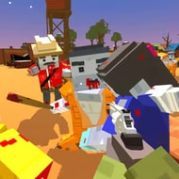









In Pixel Gun Survival you start with a basic pistol and an open map, which matters more than it sounds like it should — there’s no early-game grace period here, just a scoring system that starts counting the second the first wave spawns and never really lets up.
| Genre | Wave-based pixel-art survival shooter |
| Objective | Survive escalating enemy waves, no defined finish line |
| Arsenal | Pistols, shotguns, assault rifles, sniper rifles, rocket launchers |
Enemies arrive in discrete waves rather than a constant trickle, which gives Pixel Gun Survival a rhythm most endless shooters lack — there’s a brief lull between waves to reposition or clean up whatever’s left, followed by a noticeably larger, tougher group the moment the next wave kicks in. Players who treat that lull as downtime rather than prep time tend to fall behind fast once the pixel enemies start arriving in numbers a starter pistol can’t keep pace with.
The score climbs based on both how many waves are survived and how many enemies are eliminated along the way, which nudges play style toward aggressive clearing rather than pure survival-by-avoidance — standing still and picking off stragglers scores lower than actively pushing through a wave before it fully surrounds you.
The arsenal in Pixel Gun Survival covers a wide spread of playstyles, from close-range shotguns that clear a crowd in one blast to sniper rifles that reward precision over volume. Beginners tend to default to whatever weapon feels strongest against a single enemy, without accounting for the fact that later waves arrive in groups, where a wide-spread weapon consistently outperforms a slower, single-target one.
Rocket launchers and other special weapons sit at the top of the upgrade curve specifically because they solve the group-density problem sniper rifles can’t, though they come with slower fire rates that punish a player caught reloading mid-wave.
There’s no finish line in Pixel Gun Survival by design, and that’s exactly the point for players chasing a personal-best wave count rather than a story or a defined ending. The blocky, Minecraft-adjacent art style keeps the chaos readable even when a wave floods the screen with enemies, which matters more than it might seem for a game that leans entirely on player positioning and target prioritization rather than reflex-only aim.
The honest trade-off players discuss most is that the format is repetitive by nature — every wave is a variation on the same core loop of clear, reposition, upgrade — and whether that repetition stays satisfying long-term comes down to whether a player is chasing a higher score or just looking for a quick, disposable session.
Pixel Gun Survival earns its replay value from that same repetition, not despite it — every fresh run resets the wave counter back to one, and the pull to beat a previous score is what turns a simple pistol-start into another attempt at pushing one wave further than last time.