







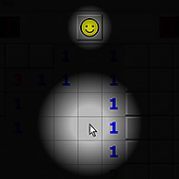
You open the first tile in IT’S JUST MINESWEEPER and everything looks right: a nine by nine grid, ten mines, a small yellow smiley at the top and numbers spreading out exactly like the 1990s classic you remember. That is the first thing worth distrusting. This puzzle-horror game keeps the rules of ordinary Minesweeper on the surface and then spends six boards quietly breaking them, one at a time.
The board is the classic grid at its most familiar: nine columns, nine rows and ten hidden mines. Left click opens a tile, right click plants a flag, and clicking a number that already has the right flags around it clears every neighbor at once, the move veterans call chording. F2 starts a fresh round and M mutes the sound, so the entire control set fits in your head before the first click.
Phones are supported too: you tap to open a tile and hold to flag it, which replaces the right click without making the board feel cramped. Beginners tend to over-flag, planting a flag on every tile that merely looks suspicious, and that habit hurts more than usual here because the numbers are the only reliable information on screen.
An interactive tutorial walks through the basics, so someone who has never opened a Minesweeper grid can still follow the logic. That matters because every later surprise depends on knowing what normal looks like.
Every board is generated to be fair, which means you never have to guess. Anyone who has lost a long run to a forced fifty-fifty knows how rare that promise is in the classic format, where luck can end an otherwise perfect chain of deduction. Here the numbers always give you a logical next step, and the puzzle stays pure logic from the first board to the last.
That fairness is the quiet engine behind the horror. When a board behaves strangely, you cannot blame bad luck or a sloppy generator, so the only explanation left is that the game wants you to notice something. Players who love deduction puzzles get a clean challenge, while horror fans get a setup where unease has to come from the rules themselves.
A cheap loss would break the spell, and the no-guess promise removes that option.
The structure is exactly what the pitch says: six boards, and each one quietly breaks a rule. The game never announces which rule has gone wrong, and the page itself says you will figure it out, followed by a hesitant probably. Once the first broken rule appears, every later board gets read with suspicion, which is exactly the mood the game is aiming for.
Spoiling which rule breaks where would flatten the surprise, so the practical advice stays general: treat each board as a new puzzle with one unknown variable. Instead of assuming you misread a number, ask which part of the usual logic has stopped holding. That approach also keeps you calm, which is useful when the game is trying to do the opposite.
A full run lasts about fifteen minutes and includes two endings, which gives the game a clear reason to replay if the first result leaves you curious. The short length keeps the pacing tight, since six boards is enough to build dread without overstaying its welcome.
Every Minesweeper board since the 1990s has a small yellow smiley above the grid, usually a reset button that changes its expression when you win or lose. The pitch tells you not to worry about it: the smiley is fine, it has always been there, and it is just watching the board. That single line rewrites the most harmless element on screen.
Nostalgia is part of the hook, and players who grew up with the original on an old desktop feel it most. One commenter said the game took them straight back to childhood, which shows how much of the effect depends on the familiar look. A face button that suddenly feels like an observer works because you already trusted it. Videos of full runs are already circulating among players.
Do not expect a plot explained through text. The unease comes from small changes around the grid: the smiley, the sound and the way a board that should be ordinary refuses to stay that way.
The page is direct about the content: jump scares, flashing lights and a very normal smiley face. It also recommends playing with headphones, at night, alone, which tells you how much of the fear depends on sound and timing instead of difficulty. The puzzles are fair, so the scares are the real test.
That is also where the game becomes divisive. A calm logic puzzle that cuts into sudden audiovisual shocks will thrill some players and put others off, and anyone sensitive to flashing lights should think twice before starting. The M key mutes the sound, but muting does not remove the visual side, so decide in advance how much you want to take.
Minesweeper purists may also bristle at the interruptions, since the original is a game about quiet concentration. Players who enjoy psychological horror built on small wrongness will likely forgive that, because the interruptions are exactly the point.
The game runs directly in a browser with no download, and it works on phones, so trying it takes almost no effort. That low barrier suits a puzzle that only takes about fifteen minutes, since you can finish a full run in one short sitting without planning an evening around it.
Streamers and YouTubers are explicitly welcome to record it, monetize it and scream at it, which fits a game built on reactions. Watching someone else’s face when a board breaks its first rule is half the fun, and the short length makes it easy to share with friends.
Short-session players will appreciate how little time it asks for, and anyone who finishes with one ending can go back for the other, since two endings give a natural second reason to return to the grid.
IT’S JUST MINESWEEPER is worth a quiet fifteen minutes if you enjoy logic puzzles that turn on you, because the no-guess boards make every strange moment feel deliberate and the smiley never stops watching. Learn what normal looks like, notice which rule breaks on each of the six boards, and see which of the two endings you land on.