








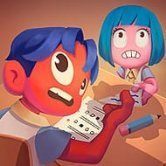
You slide a textbook across the desk, whisper the answer through a walkie-talkie, and hear the teacher’s footsteps turn toward your row: Finals Week makes exam survival a team operation. The goal is not to master the syllabus but to get your whole squad through a series of increasingly difficult tests without being caught. Up to four players share the same risk, so one careless move can ruin a plan that looked perfect a moment earlier. The comedy comes from treating ordinary classroom objects as a high-stakes toolkit, while the stealth loop keeps every exam tense.
| Genre | Co-op stealth, party simulation |
| Players | 1–4 |
| Setting | A dysfunctional school during exam week |
| Core objective | Pass each exam together without getting caught |
| Progression | A sequence of increasingly difficult exams |
The basic loop is easy to understand: locate useful answers, move information between classmates, and avoid drawing the teacher’s attention. Textbooks can be found and passed around, while cellphones, walkie-talkies, and binoculars help the squad share information across the classroom. The teacher patrols, listens for suspicious activity, and can throw erasers with startling accuracy. A successful run depends on reading the room as much as knowing where the answers are.
Beginners often focus on collecting tools and forget to agree on who is doing what. That creates noisy movement, duplicated effort, and last-second handoffs in the teacher’s line of sight. A group that assigns one player to scout, one to relay answers, and another to create distractions has a much clearer plan. Players who enjoy stealth games will recognize the value of patience: wait for a safe opening instead of trying to complete every action immediately.
Communication is the real resource. Proximity chat and quick callouts can turn a messy classroom into a coordinated operation, but constant chatter can also make the team lose track of the teacher. Keep messages short and specific: name the answer source, the route, and whether the teacher is approaching. A player who watches patrol patterns can be more useful than someone sprinting around with every available gadget.
Each tool solves a different problem rather than simply making cheating effortless. Binoculars help inspect information from a distance, while a cellphone or walkie-talkie can move an answer to a teammate who cannot safely cross the room. Paper, throwable objects, and classroom equipment create distractions, and the pen that doubles as a tranquilizer blowgun adds a particularly absurd option. Drawing on desks, walls, sheets, and even friends is another way to turn the environment into a shared notebook.
The most common failure is using a tool without considering what happens immediately afterward. A distraction may pull attention away from one player while exposing another, and a teammate who receives an answer still needs time to use it. Getting caught can mean restraints such as the Cone of Shame, which make later actions harder rather than ending the comedy outright. Treat every risky action as a trade: what does the team gain, and who has to deal with the consequence?
Between exams, the school hall offers a change of pace. Players can shoot hoops, throw baseballs, decorate statues, and plan the next attempt while unlocking outfits and accessories through exam progress. These breaks matter because they give the group room to reset after a chaotic test. The cosmetic rewards also create a light rivalry over who carried the squad, even though the actual objective remains collective.
The challenge rises as the exams progress, and the level layouts and interactions ask players to pay closer attention. Recent updates have adjusted the readability of mechanics in levels 6, 8, 11, and 12, and added hints for Graduation Mode after a failure. The encrypted-answer board on level 5, for example, rewards players who stop and inspect the information rather than rushing past it. The alarm clock’s ticking sound is another useful cue when you are close to it.
By later exams, a reliable team needs more than a single trick. Rotate responsibilities so the same player is not always exposed, keep track of who has a useful item, and make a fallback plan for when the teacher interrupts a handoff. Players who like improvisational co-op will enjoy the stories that emerge from failed plans; players who prefer predictable stealth may find the physics and teacher behavior occasionally chaotic. That unevenness is part of the appeal, but it can also make a clean run feel less controllable than expected.
Community talk around the game naturally centers on squad coordination, teacher awareness, and the funniest ways to get caught. The most satisfying moments are often tiny: a textbook reaches the right desk just before the teacher turns, or a distraction buys one teammate enough time to finish a question. The less satisfying moments come when several players act at once and nobody is watching the patrol. A little structure makes the slapstick more enjoyable, not less.
Finals Week supports a squad of up to four players. The team passes or fails together, so even a confident solo player benefits from clear callouts and shared responsibilities. A smaller group can still divide scouting, answer gathering, and distractions between its members.
Textbooks, cellphones, walkie-talkies, and binoculars are among the useful tools for moving information around the classroom. Each has a different practical role, so choose based on distance and the teacher’s position. A quick handoff is only helpful if the receiver has a safe moment to use the answer.
Watch the teacher’s patrol and avoid crossing the room or talking at the wrong moment. Use distractions to create a brief opening, then move only the teammate or information that needs to move. If someone receives the Cone of Shame or another restraint, change the plan rather than forcing the same risky route.
Finals Week works best when the squad treats the classroom like a shared stealth puzzle: one player tracks the teacher, another moves the textbook, and someone else keeps the walkie-talkie ready. The teacher’s erasers, the Cone of Shame, and the changing exam layouts make every clean pass feel earned, while the school hall gives the group a place to laugh at the mistakes before the next test.