




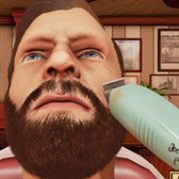
You line the clippers up along a client’s temple, confident, steady hand — and watch the blade phase straight through skin instead of catching hair the way a real razor would. That’s your welcome to Barbershop Simulator, a game that looks like a relaxing shop-management sim in every screenshot and plays like a genuine test of hand control the moment the first customer sits down.
| Genre | First-person barber simulation |
| Tools | Clippers, straight razor, comb, scissors |
| Goal | Deliver the haircut and shave each customer actually asked for |
The core mechanic sounds simple on paper: hold the razor near the face, move the mouse to shave. In practice, the tool tracks distance from the skin in a way that punishes even small hand drift, so a razor that should be gliding along a jawline instead veers toward the chin or cheek and misses the surface entirely. New players spend their first two or three customers just learning where the actual contact zone is, since the game gives no on-screen indicator for it.
Clippers behave a little more forgivingly, but they carry their own timing problem — moving too fast skips patches of hair, too slow buzzes a line shorter than intended. Most first-time players agree the razor is the harder tool, and the community has largely settled on starting every session with a buzz-cut client before attempting a straight-razor shave.
Every customer who sits in the chair arrives with a specific request, and Barbershop Simulator expects you to actually match it rather than just cut generically. That means noticing whether someone wants length kept on top with a tight fade on the sides, or an even trim all around, and adjusting clipper guard length and razor angle accordingly instead of running the same default pattern on everyone.
Getting it wrong doesn’t just look bad — it changes how satisfied the customer is when they leave, which nudges the pacing of the whole session. Players who rush through requests without checking twice burn through customers faster but end up redoing more cuts than those who slow down early.
The most consistent complaint isn’t the difficulty, it’s the control precision itself — players report the razor moving on its own without deliberate input, or refusing to shave cleanly even when close to the face. It’s a real rough edge the game never fully resolves, but it hasn’t stopped clips of chaotic, disastrous haircuts from becoming most people’s first exposure to the game.
There’s a quieter appreciation running alongside the chaos too: the shop itself, the chair, the mirror, the tool rack, all read as more polished than the difficulty curve suggests, which is part of why players stick around past the frustrating early haircuts.
Barbershop Simulator earns its reputation less from being a smooth simulation and more from how honestly it lets things go wrong — a razor that won’t behave, a fade that turns lopsided under your own hand, and a customer’s reaction that makes it impossible to pretend the bad haircut didn’t happen.