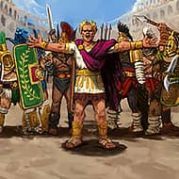
Dominus Gladiatus looks like a bloody arena brawler from its screenshots, but it plays like a ledger where every entry is a living man. You never pick up a sword yourself. As the Dominus, you decide who eats, who trains, who rests and who walks onto the sand, and then you watch the auto-battler fights play out with your hands off the controls.
| Genre | Gladiator management simulation with auto-battler combat |
| Setting | Ancient Rome |
| Mode | Single-player |
| Your Role | Dominus, master of a Ludus |
| Rival Schools | Five rival Domini |
| Season Length | 160 days leading to a grand final |
Every run starts with a choice between six Domini, and each one comes with their own strengths, methods and path to prestige. The five you leave behind do not disappear. They become your rivals, building their own schools and meeting you one by one across a 160-day tournament that ends in a grand final. That structure gives the game a clear shape, because you are not grinding endlessly but racing a calendar toward a single championship.
Your Ludus is the base of operations. You expand it with new facilities, train your gladiators and develop their skills, and between fights it is where most of your real decisions happen. Players who enjoy juggling a squad, with all its rotation and favorites, will recognize the rhythm at once. The fights decide the result, but the Ludus decides who is still standing for them.
The loop is easy to describe and hard to master. You recruit, train, equip, fight and recover, then do it all again with a slightly thinner roster and a slightly louder crowd.
Early in the game your roster is thin, and the slave market is where you fix that. The markets of Rome are full of desperate men, and every recruit arrives with different strengths, weaknesses and possibilities. The detail that matters most is hidden potential. A recruit who looks ordinary on first inspection can grow into a champion with the right training, while a fighter who looks impressive today may not be the better long-term investment.
Money is the obvious constraint, and it pushes you to think of your roster as a portfolio rather than a collection of favorites. A balanced roster gives you options when injuries hit, and injuries will hit. Because the game carries perma-death, every purchase is also a bet that the man you buy survives long enough to repay what you paid for him.
Spending everything on one star is the classic early mistake. If he gets hurt, or worse, your Ludus has nothing behind him, and the calendar keeps moving whether you have a replacement or not. Roster depth is not exciting, but it is what keeps a school alive past the first rough stretch of the tournament.
A gladiator is more than a stat line. Morale, fatigue, injuries and discipline all shape how he performs when steel starts moving, so your preparation between fights matters as much as the fight itself. Sending an exhausted or wounded fighter into the arena can solve today’s problem, which is usually an empty slot on the roster, while quietly damaging your school’s future.
The mistakes new Domini are most likely to make follow a pattern:
Cautious planners who like to rest first and fight second will find the game rewards patience. The 160-day calendar keeps pressing, though, so every day of rest has a price, and deciding who can be pushed further is where the management layer shows its teeth.
Gear is how you turn a recruit into a fighter with a purpose. Roman blades, shields, helmets and armor can be matched to the role a gladiator plays, and the right loadout can lift an unproven fighter into a contender. Combat comes in savage duels and in team battles, which means you are thinking about individual condition in one case and about how your roster fits together in the other.
A sensible routine before any fight runs in this order:
That last step is the defining moment of the game. The second the fight begins, your role goes quiet, and everything you could have changed has already been changed. Preparation is the only lever you have, and that is exactly why the auto-battler format feels tense instead of passive.
Rome remembers spectacle. Win the crowd and it may turn the arena to your advantage, but turn it against you and the crowd becomes another opponent. Spectacle and reputation may be worth as much as clean efficiency, so a fighter who entertains can matter as much to your Ludus as one who simply wins.
Rival Domini add pressure from the other side, since each has their own methods for disrupting your school. Early in the tournament they are a distant problem. By the time the later rivals start getting in your way, the weaknesses in your roster have usually become visible, and the grand final feels less like a distant goal and more like an exam you have been studying for.
Not everyone will love the design. Players who want direct tactical command may feel locked out by the auto-battler fights, and the permanent loss of fighters can sting. The content is also unapologetically violent, with blood and decapitations, so it is worth knowing what you are signing up for.
No. Combat is an auto-battler, so you prepare your gladiators and then watch duels and team battles resolve on their own. Your influence comes from training, gear and roster choices, plus how well you manage morale, fatigue and injuries before the fight.
Yes, and one mistake can cost a gladiator his life. Sending an injured or exhausted fighter into the arena is the fastest way to lose someone you invested in. Resting him, or replacing him with a healthier recruit from the slave market, is usually the safer call.
Six Domini compete in a 160-day tournament. You choose one to lead, face the other five one by one, and fight toward a grand final. Each rival has their own methods for disrupting your Ludus along the way.
Dominus Gladiatus rewards players who treat their Ludus as a long argument with Rome rather than a string of separate fights. Every purchase from the slave market, every day of rest you grant or deny, and every moment you play to the crowd feeds into a 160-day road toward the grand final. Pick your Dominus, protect your roster, and remember that in the arena only one name is remembered.