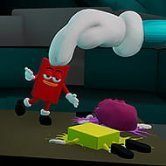










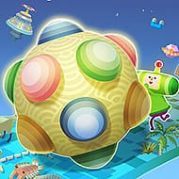
You steer the Prince across a Japanese-style home, the katamari swallowing everything small enough to stick, until you slam into something far too large and bounce away with objects tumbling off behind you. That cycle of growing, colliding and regrouping drives Once Upon A KATAMARI, where the King of All Cosmos has wrecked the stars again and the Prince must roll through time to rebuild the night sky.
| Genre | Puzzle action adventure |
| Playable characters | The Prince and 68 cousins |
| Goal | Roll up objects to rebuild the starry sky |
| Power-ups | Magnet, Rocket, Radar, Clock-stopper |
| Multiplayer | KatamariBall against other players or CPU opponents |
The rule under every stage is easy to explain and hard to stop thinking about. Anything smaller than your katamari sticks to it, anything larger sends you bouncing away, and each stage sets a size you must reach before the timer runs out. The story reason is the King of All Cosmos fiddling with a scroll and crushing the Earth, the Moon and the stars, so the Prince has to gather enough matter to restore them.
What makes the game work is that growth changes the stage itself. A room that feels like a maze of furniture at the start becomes a buffet once the katamari has swelled, and corners that were blocked off open up because you can finally roll over whatever stopped you before. Players tend to describe the moment a stage flips from scavenging to devouring as the best part of every run.
Steering relies on the dual-stick control the series is known for, and reviewers note that the core handling has barely changed from earlier entries. That is comforting for returning players and slightly underwhelming for anyone hoping for a reinvention.
The classic beginner mistake is charging at the biggest object in view before the katamari is ready. A hard hit on something too large knocks pieces off and shrinks your total, and with a countdown running that loss hurts more than it looks. Experienced players circle the area, collect mid-sized clutter first, and return to the giant object only when it will actually stick.
A second habit that costs time is rolling in long straight lines. Stages reward sweeping loops through dense areas, because every pass through a crowded spot adds more size than a trip across empty floor. Puzzle fans often pick this up fast, while action fans usually need a few failed attempts before they stop sprinting.
Difficulty is one of the things people disagree on. Some players find the game relaxed from start to finish, others call it a little tougher than earlier entries, and certain stages demand quick planning rather than leisurely rolling. Early stages are the place to practice routing, because that planning matters more as you go.
Power-ups are the biggest new idea, and they appear inside stages rather than being something you carry in. Four of them come up in reviews and player talk, and each one changes how you route a stage:
Once the Magnet shows up in a stage, the route you planned changes, because a patient sweep can now collect a whole cluster without chasing each piece. The Radar works differently, turning a stage into a map of optional goals and letting completionists decide whether a detour is worth the seconds.
Not everyone loves how much help the game gives. Some series veterans feel the power-ups soften the challenge, while others enjoy the extra decisions about when to spend each one. The answer mostly depends on whether you want a relaxed roll or a tight run.
The central gimmick is time travel, and the stage list reflects it. The Jurassic Period, the Ice Age and historic Japan appear in the official description, while reviews also mention underwater wonderlands, Japanese-style homes and Western saloons with cowboys and tumbleweeds. Each era swaps the clutter you collect, so rolling up a saloon feels nothing like rolling up a living room.
Between missions you move around small hubs to pick what to play next, which gives the game a sense of travelling from world to world instead of clicking through a menu. By the time you reach the Wild West stages, tumbleweeds and cowboys replace household clutter, and the change of scenery is half the fun.
Players who enjoy visual gags get the most out of this part, since every era turns ordinary props into comic material for the katamari to swallow. The King of All Cosmos stays at the centre of the story, which keeps the jumps between eras feeling like one silly adventure.
Beyond the size target, every stage hides extra goals. Presents unlock cosmetic pieces such as sunglasses and scarves, cousins are other playable characters, and crowns are the hardest collectible to find. Crowns and cousins also matter beyond bragging rights, since collecting them helps unlock more stages in other eras.
The cousin roster reaches 68, and unlocking one generally means spotting the cousin inside a stage and rolling them up. Cousins have no special powers, so the choice is purely about looks. After each stage you can check which presents, crowns and cousins you missed, which turns a failed hunt into a plan for the next attempt.
Collectors will happily spend hours on this, while casual players can treat most of it as optional. The multiplayer KatamariBall mode gives the cosmetics a purpose, because the Cousin Creator lets you change hats, expressions and bodies so your cousin stands out against other players or CPU opponents.
You can play as the Prince or pick from 68 cousins, and they mostly unlock by finding them in stages and rolling them up. Cousins carry no special powers, so you can choose a favorite without hurting your run. The Cousin Creator adds more variety through hats, expressions and bodies.
Crowns are optional collectibles hidden across stages and are considered the hardest of the three extras. Collecting them, along with cousins, helps open stages set in other eras. The Radar power-up shows where they are, which saves time when you are chasing a high rank.
No, the Magnet only pulls in nearby objects that are small enough for your katamari to take. Anything bigger than you still bounces you away, so grow first and use the Magnet in crowded areas. Good timing is what separates a clean sweep from a wasted power-up.
Once Upon A KATAMARI succeeds because the loop of rolling, growing and swallowing never loses its silly charm, whether you are chasing crowns across the Jurassic Period or clearing a saloon with the Magnet. The Prince, the King of All Cosmos and a roster of 68 cousins give the game a warm, odd personality, and the sky really does feel rebuilt one stubborn object at a time.