








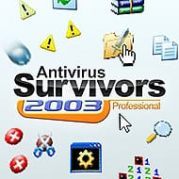
The achievement list calls it “Defrag the System,” and that name alone tells you what kind of fight you’re walking into. Antivirus Survivors 2003 Professional drops you inside a single family computer during the worst possible week — pop-ups multiplying, the fan screaming, and something crawling through the C: drive that definitely wasn’t there yesterday. You’re not playing a soldier or a wizard. You’re playing the last line of defense on a machine that should have been retired years ago, and the game leans hard into that premise instead of dressing it up as anything grander.
There’s no overworld, no branching regions to unlock in the traditional sense — the entire game plays out on and around this one infected desktop, and that constraint is doing more work than it looks like at first glance. The CRT glow and dial-up static aren’t just skin; they set expectations for pacing. Waves come from the edges of the screen the way pop-up windows used to stack on old monitors, and the sound design leans on that dial-up hum specifically to keep you anxious even during the quiet seconds between spawns.
Newer players tend to treat the opening minutes like a warm-up lap, which is the first real mistake the game punishes. Enemy density ramps faster than the tutorial pacing suggests, and by the time the second wave hits, players who were still learning their cursor’s attack range are already scrambling. Casual players who just want short, chaotic sessions tend to get exactly what they came for here, since a full run rarely stretches past the length of a coffee break gone wrong.
What’s easy to miss on a first run is how much the game telegraphs danger through visual noise rather than clear warning icons. A cluttered screen isn’t just aesthetic chaos — it’s genuinely harder to track your own health bar when three adware windows are flashing at once, and that’s intentional friction, not a bug players should expect patched out.
The weapon roster is small early on but expands with names pulled straight from a 2000s toolbox. Pinball fires in unpredictable bouncing arcs that reward tight corners over open space, while C: Drive functions more like a sustained beam that punishes players who keep drifting instead of holding a lane. Firewall, by contrast, is less about damage output and more about denial — it blocks incoming attacks along a fixed line rather than clearing enemies outright.
Weapon pairing matters more than raw stats here. Running Pinball alongside Firewall means leaning into a defensive, corner-based loop, while pairing C: Drive with a mobility-focused stat build turns the run into something closer to kiting. Speedrun-minded players gravitate toward the second approach specifically because it minimizes the dead time between engagements.
One frequent complaint in the community is that mid-run weapon evolutions can feel invisible unless you’re actively watching your damage numbers tick up. That’s a fair criticism, and it’s worth naming directly rather than glossing over: the feedback on when a weapon has actually upgraded could be clearer, and plenty of players have said as much in discussions after a run.
Antivirus Survivors 2003 Professional gives you eighteen separate stats to shape a build around, and the temptation is to dump everything into damage immediately. Luck is the stat beginners undervalue most — it quietly governs drop rates and plugin frequency, meaning a low-luck run can feel starved of options even when damage numbers look fine on paper.
Speed and damage still form the backbone of most viable builds, but they interact with survivability in ways that aren’t obvious from the stat screen alone. A high-speed, low-damage build changes how you play the game entirely, turning fights into extended kiting sessions rather than head-on stands.
Min-maxers who track exact percentage thresholds will find plenty to chew on here, since stat scaling isn’t perfectly linear across all eighteen categories. That imbalance is one of the more debated points among players who’ve logged serious hours — some see it as intentional build diversity, others as an area still needing a pass.
Thirty-seven plugins sit behind the game’s keygen system, and opening one mid-run is where builds genuinely diverge from each other. Plugins modify weapons and stats simultaneously rather than offering flat upgrades, so a plugin that boosts Firewall’s uptime might quietly reduce your movement speed as a tradeoff.
Early in the game, plugin choices feel almost cosmetic since stat pools are small. Once the run stretches longer and stacking effects compound, plugin selection becomes the single biggest lever a player has over how a build actually performs. This is also where the “what plugins should I prioritize” question that shows up constantly in community discussions actually gets answered in practice rather than theory — luck-boosting plugins tend to snowball fastest because they increase the odds of finding more plugins.
Five difficulty tiers, framed in-game as protocol folders, structure the long-term climb. Meta upgrades — eighteen in total — persist between runs and are the intended answer to the question of how difficulty changes as you progress: the early protocol folders are forgiving enough to build up meta currency, while the higher folders assume you’ve already invested in survivability upgrades before walking in.
Jumping straight to a higher protocol folder without meta investment is the second major mistake newer players make, right after underestimating early wave density. The difficulty curve isn’t gentle once you’re past the second folder, and enemy adware variants start appearing with attack patterns that simply don’t exist earlier in the game.
Completionists chasing every achievement will spend the most time here, since several unlocks are tied to clearing specific protocol folders under stricter conditions rather than just surviving them.
None of these are dealbreakers, but they come up often enough in discussions to be worth naming plainly rather than pretending the game is flawless.
Strip away the CRT filter and dial-up sound cues, and Antivirus Survivors 2003 Professional still holds up because the systems underneath — the plugin tradeoffs, the protocol folder scaling, the way Firewall forces you to think in lanes instead of open space — are built with enough intention to survive the joke. It’s a game that knows exactly what its premise is worth, and it doesn’t overstay that premise past the point where the joke would start covering for the mechanics.