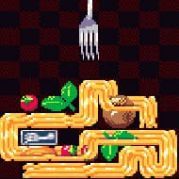
You steer a long strand of spaghetti down the screen in Spaghetti Celesti: Devour the Heavens, and a garnish lands at an angle that refuses to tangle. The forchettata you were building now has a gap, and the next piece is already falling. That small panic, somewhere between a falling-block puzzler and a plate of pasta, is the core of the game.
A forchettata is an Italian forkful, and the aim here is to build the best one possible: the longest strand of pasta, loaded with small garnishes and rolled neatly. Pieces drop into the play area in the familiar rhythm of a falling-block puzzler, so you watch what arrives and decide where it fits. The twist is that the thing you are shaping is one excellent strand rather than a tidy stack, and that changes how you plan every placement.
Players sum it up as Tetris with spaghetti, and the shorthand fits well enough to get newcomers started.
Where the classic genre rewards clean, compact stacking, this game rewards connection and length. Beginners often treat each falling piece as a plain block, dropping it wherever there is space, and then wonder why the strand looks ragged. The better habit is to think about how the next piece will join the last one, because a neat join now saves trouble later.
A good forchettata is also satisfying to look at, which gives even a mediocre run a reason to keep going.
The little foods are what separate this from a plain pasta puzzle. Players point out that the ingredients you have to tangle into the spaghetti add variety and challenge, since each garnish asks for slightly different handling. One player compared the game to a snake-style arcade classic, noting that the garnishes are what give it extra depth.
Advanced players talk about chaining forks into forks, and at least one wants a scoring bonus for doing it. That request shows how much potential the system has for long combinations, and it hints at where score chasers will eventually push.
As a run goes on, every placement closes off a few options, so early choices matter more than they seem. Planning ahead beats reacting, and the players who enjoy quietly arranging a clean strand will get more from this game than those who prefer fast reflexes.
Difficile is the harder setting, and it is where the scoring system gets its workout. The scoring draws praise, and one player reported reaching 4.6 over 15 reviews on Difficile before having to stop, which suggests how easy it is to lose an afternoon.
The criticism is worth stating plainly. Some players say certain angles when combining spaghetti do not feel right, with a join looking like it should connect but not behaving that way. In a puzzle built around precise tangling, that kind of mismatch can be frustrating, especially on the harder setting.
Most feedback is warm, though. Several players describe the game as surprisingly intuitive, getting the hang of it after a few tries and enjoying a second run much more than the first.
The game plays with a keyboard or a controller, including Xbox and PlayStation pads and other gamepads. A controller suits a relaxed session on the couch, while a keyboard is fine for quick runs at a desk.
A complete tutorial walks you through the basics before your first plate, which matters because the mechanic is unusual. It helps to go through it once even if you know the genre well, since the pasta rules differ from ordinary block stacking.
Sessions last only a few minutes, so the game fits short breaks, but the urge to try for a better forchettata often stretches them. Expect a lot of one-more-try moments.
The presentation plays like a restaurant, with a warm welcome and Italian words scattered through the menus and text. Terms like forchettata and Difficile give everything the flavor of a menu card, which suits the theme without getting in the way of play.
Comments are full of hunger jokes, with one player saying they wanted a big plate of pasta afterward. Another player imagined the game on a Game Boy Advance or Game Boy Color, praising smart design on simple hardware, which says a lot about how compact the idea is.
The appeal is that the concept fits in one sentence but takes practice to master. That combination of simple rules and real depth is what keeps a puzzle game on someone’s screen for more than a few sessions.
Spaghetti Celesti: Devour the Heavens turns a familiar falling-block idea into a plate of tangled pasta, where every garnish and every angle shapes the forchettata you are building. Whether you chase a high score on Difficile or simply learn the tutorial, the game delivers quick, satisfying sessions. Keep an eye on those forks, and do not be surprised if you finish with an appetite.