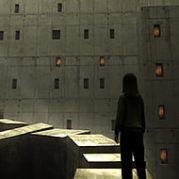
You hit the edge of a crumbling concrete rooftop at full speed, string your moves together into a jump you were not sure you could make, and land on a shortcut that shaves precious seconds off your time, all so Robert can get his family’s ration tickets back from the Ministry. VHOLUME is a first-person parkour adventure where bureaucracy is the villain and movement is the only way to fight back.
| Genre |
First-person parkour adventure |
| Protagonist |
Robert |
| Levels |
62 |
| Combat |
None |
| Goal |
Recover your family’s revoked ration tickets from the Ministry |
Robert and the Ministry’s Paperwork in VHOLUME
The story is refreshingly small. Robert is not a soldier or a chosen one; he is an ordinary citizen of a derelict, dystopian capital whose family has had its ration tickets revoked. Getting them back means reaching the Ministry, which sits on the far side of a labyrinthine city of brutalist concrete, abandoned industrial sites and surreal megastructures. A simple administrative errand becomes an odyssey across the whole map.
That modest goal is exactly what makes the journey feel personal.
There are no weapons, no enemies to defeat and no combat loop. The threat is systemic: locked doors, impenetrable offices and a city designed to keep people in their place. The tone is melancholic rather than heroic, and the overgrown, crumbling architecture turns every level into both scenery and obstacle course.
Momentum, Chains and Honest Controls
The basic controls are intentionally simple, so the first few levels feel approachable even for players who rarely touch parkour games. The depth comes later. Players who dig into the movement system discover they can build more and more speed, chain movements together and even skip entire sections with well-timed jumps. The gap between a first clear and an optimized run is enormous.
Beginners usually lose time by stopping. Hesitating at a ledge, slowing down to look for the next handhold or landing awkwardly bleeds the momentum that the whole system is built on, so learning to keep moving through small mistakes pays off faster than learning any single trick.
Rooftops, Shafts and Concrete Walls
Levels send you racing across rooftops, down shafts and along towering concrete walls, with abandoned industrial facilities and strange megastructures breaking up the rhythm. Each environment encourages different lines: rooftops reward long, fast chains, while shafts and walls demand precise timing.
By the time you reach the megastructures, the city stops feeling like a maze and starts feeling like a playground you finally understand.
Target Times and the Hunt for Shortcuts in VHOLUME
Many of the 62 levels offer multiple routes and hidden shortcuts, and that is where the real appeal lives. Instead of simply finishing a level by any means necessary, the goal becomes finding the perfect route, optimizing each movement sequence and cutting a few more seconds off your personal best on every attempt.
- Finish the level cleanly first to learn its layout.
- Replay it looking for alternate paths and shortcuts.
- Test risky jumps that might skip whole sections.
- Combine the best pieces into one chained run against the target time.
Speedrunners will feel at home immediately, because the level design is built to be broken. Community chatter is full of route talk, PBs and debates about whether a particular skip is actually faster once you account for the landing.
Players who prefer exploration can still enjoy the city at their own pace. The target times are an invitation, not a gate, and plenty of people finish the story before coming back to chase numbers.
Pacing Between Melancholy and Speed
That dual identity is also where opinions split. The slower, contemplative mood of the city and the speedrun-focused level design pull in slightly different directions, and some players wish the game committed harder to one side. Others love being able to switch between wandering and racing whenever they want.
The minimal story is another talking point. Robert’s quest is intentionally modest, and players looking for a big narrative payoff may find it too quiet, while those who enjoy environmental storytelling appreciate how much the architecture says without words.
Fans of classic first-person parkour games often draw comparisons, and the consensus is that the movement holds up on its own terms. The simple controls keep it accessible, and the ceiling is high enough to keep dedicated runners busy long after the credits.
VHOLUME Questions From First-Time Runners
- Is there any combat? No. There are no weapons and no enemies to defeat. The obstacles are the city itself and the Ministry’s bureaucracy, so all of your skill goes into movement.
- How many levels are there? There are 62 levels, and many of them hide multiple routes and shortcuts, which is why a single level can be replayed many times without feeling identical.
- Do you have to beat the target times? Target times are the challenge layer for players who want to optimize. Many runners finish Robert’s journey first, then return to individual levels to chain movements and shave seconds off their personal bests.
VHOLUME turns a trip to the Ministry into one of the most satisfying movement challenges around: learn the simple controls, keep Robert’s momentum alive across rooftops and concrete walls, and hunt for the shortcut that finally beats the target time on your favorite level. The Ministry may be impenetrable, but the city is not.