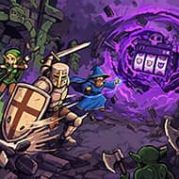
You pull the lever in Slotbound, nine symbols spin into a 3×3 grid, and two lines almost match before the last reel lands on the symbol you needed. A Prism unit drops onto the battlefield, the screen floods with light, and for a few seconds the run feels already won. Then a judgement wave arrives and reminds you that a jackpot only opens the door, while the decisions you make afterwards decide whether you walk through it.
| Genre |
Roguelike auto-battler defense |
| Core system |
3×3 slot machine summoning |
| Players |
Single-player |
| Campaign |
Six stages with multiple difficulty levels |
| Progression |
Permanent upgrades between runs |
Pulling the Lever: How Summoning Works in Slotbound
Everything in a run starts at the slot machine. Each spin of the 3×3 grid summons units, and matched lines trigger the larger payouts, so the machine is your only source of an army. Because this is an auto-battler, your units fight on their own once a wave begins, which means all of your real decisions happen before the fighting starts. Players coming from classic tower defense often look for a placement tool that is not there, and it usually takes a run or two to stop reaching for it.
A spin is never just a head count. Every unit that spawns rolls from dozens of Random Stats, so two Warriors from the same spin can behave quite differently, and some units also carry an Imprint that gives them their own quirk. Reading those rolls before you commit is the first habit that separates stable runs from lucky ones.
Jackpots are the moments people remember, yet the systems around the machine exist so that you never have to depend on one. That balance between spectacle and planning is what the game keeps returning to, spin after spin.
Absorb, Evolve, Promote: Turning Weak Units Into Strong Ones
No summon is wasted, because weaker units can be sacrificed to feed stronger ones. A plain 1 star Warrior that looks like filler can be absorbed into another unit and push it toward a promotion, where branching class choices change what that unit becomes. Early in a run this is how a modest board grows into a real army without waiting for a perfect spin.
The class branches matter more than they first appear. Roguelike veterans will recognise the snowball logic: one good promotion makes the next absorption more valuable, and the gap between a focused board and a scattered one widens fast. A mixed collection of classes can look impressive for two waves and then collapse once the numbers stop being forgiving.
Players who enjoy mapping out a build in advance will find the most depth here, since every absorption is a trade between keeping a body on the field and investing in a unit that has to carry the late waves. Feeding the wrong unit is a mistake you will usually notice only when a boss wave arrives.
Items and Cores: Bending the Odds in Slotbound
Items and Cores are the tools the game gives you for manipulating the odds. Cores in particular are built around synergy, which is why planning around them early produces the explosive turns players love to show off. Neither removes randomness, but both let you push a run toward a plan instead of a coin flip.
A few habits tend to separate steady runs from messy ones:
- Read the Random Stats on a unit before deciding what to feed it.
- Pair a distinctive Imprint with your Items instead of spreading Items thinly across the board.
- Treat a Core as the plan for the run and Items as the patches that keep it working.
- Keep weak units around as absorption fuel until the promotion you want is within reach.
The game openly invites players to bend RNG to their will, so finding clever loopholes is part of the intended fun rather than something to feel guilty about.
Judgement Waves and Boss Waves: Where Runs Break
Judgement waves and boss waves are the pressure points of every stage, and each of the six stages brings different enemies, bosses, and mechanics. A board that handled stage one comfortably can look thin by stage three, which is why the campaign teaches you to adapt rather than repeat one recipe.
Once boss waves appear, raw numbers stop being enough. The runs that survive tend to be the ones that prepared a Core synergy or a promoted unit in advance instead of hoping the next spin would fix everything. Players who like a clear difficulty ladder can raise the challenge through the multiple difficulty levels once the first clear is done.
There is a divisive side worth admitting. The game is in Early Access, so several progression systems and build options are still being expanded, and some players will hit a stretch of spins that simply refuses to cooperate. Whether that feels like tension or unfairness depends on how much you enjoy a roguelite that lets variance bite. Larger ideas such as an Infinite Mode and asynchronous PvP are planned but are not part of the campaign today.
Early Mistakes With Random Stats and Imprints
The most common beginner error is treating every unit as interchangeable. Because Random Stats differ from spawn to spawn, feeding your best-rolled unit into a weaker target wastes the very roll that made it special. Check the stats first and absorb second.
Another trap is chasing the jackpot. New players often spin hoping for a Prism and neglect the Items and Cores that would have stabilised the board, so a quiet, well-planned run beats a flashy one more often than expected.
Imprints cause a subtler mistake, which is ignoring them. A unit with a distinctive Imprint often deserves to be the target of your Items rather than the fuel for someone else’s promotion. Players who treat the slot machine as the whole game tend to skip these details until a boss wave exposes them.
Slotbound Questions Players Keep Asking
Is Slotbound pure luck?
No. The slot machine decides what you summon, but Random Stats, Imprints, Items, and Cores give you ways to steer the result, and absorption lets you convert weak spins into strong units. Luck sets the opening of a run, while planning decides how it finishes.
How does absorbing units work?
You sacrifice weaker units to feed a stronger one, which pushes it toward promotion and opens branching class choices. A 1 star Warrior is the classic example of a unit that looks plain until it grows into something sturdier.
What do Cores do during a run?
Cores are the synergy engines. They sit beside Items as your main way to manipulate the odds, and the explosive turns players enjoy usually come from a Core combination set up before the judgement waves arrive.
Slotbound rewards players who respect the lever without worshipping it. Pull for a Prism if the machine offers one, but the runs that reach the last boss wave are built from absorbed Warriors, carefully chosen Cores, and a plan made before the next spin.