The Message From Deep Space looks like a quiet retro-computer simulator, but it plays like a language-learning puzzle where nobody hands you the vocabulary. You sit in 1973 as the mission’s Translator while a meteorite broadcasts radio waves at Earth. Your job is to answer in a way that makes it say something new. Every success comes from spotting patterns, because no tutorial explains the alien language for you.
| Genre | Puzzle adventure built around deciphering a language |
| Setting | 1973, a mission responding to a meteorite’s radio waves |
| Your role | The mission’s Translator |
| Main tools | Retro computer, user-driven dictionary, frequency-based transmissions |
| Perspective | First-person, single-player |
| Playtime | 30+ hours |
The premise is simple and demanding. Earth receives a meteorite that broadcasts radio waves, and you design the responses. If a response is correct, the meteorite sends a new message. Patterns, words, syntax and meaning only take shape through this back-and-forth, so the whole mission is a slow conversation with something that does not share a single word with you.
You do not work alone. A meticulous linguist, a single-minded computer programmer and an affable astronomer support the mission, and they react to what you do. Their dialogue gives the story a human pulse, and it often nudges your thinking without giving the answer away.
Progress is linear, so the mission moves forward as you solve each stage rather than letting you wander. That keeps the story tight, but it also means a stuck stage can feel like a locked door.
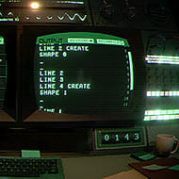
You build your replies on a retro computer by designing transmissions by frequency. The interface feels like operating real hardware rather than clicking through menus, and that physical, clunky feel suits the 1973 setting. Puzzle fans who enjoy working through logic one clue at a time will settle in quickly.
The first time a transmission earns a reply, the silence between your message and the meteorite’s answer is the most tense moment in the game. Each reply is a new data set, and a wrong guess simply means the meteorite has nothing new to say. That makes mistakes feel informative rather than punishing.
Early in the mission the transmissions are small and basic on purpose. Treat them as a foundation rather than a warm-up, because later messages assume you remember every pattern you noticed here.
The dictionary is entirely user-driven, so you decide what each symbol or sound probably means and keep the record yourself. Language fans will love this freedom, since it turns every entry into a small hypothesis. A good dictionary is organized, humble and ready to be revised.
A workable routine looks like this:
Following that loop keeps you from filling the dictionary with entries you can no longer defend, which is the quickest way to stall.
Most stuck players share a few habits, and nearly all of them come from impatience rather than a lack of ability.
When progress stops, go back to the earliest messages and reread them with your current vocabulary. Patterns that looked random at the start often resolve once you know three or four words.
The game takes its cue from the Golden Record aboard Voyager I and pursues a realistic approach to deciphering an interstellar message. It begins with the limited universal constants that any technologically advanced civilization could share, then spans real-world fields of math and science. That grounding is why the puzzles feel earned instead of arbitrary.
More than 1,000 in-game dialogues give the team room to argue, joke and doubt themselves, and a soundtrack of over 30 minutes fills the long stretches of quiet. The linguist, the programmer and the astronomer each approach the problem differently, which keeps their conversations useful as well as charming.
Science-curious players will appreciate how the mission treats real concepts with respect. Players who have never studied linguistics will still find enough footholds to keep moving.
Reception is overwhelmingly positive, and the praise centers on the feeling of genuine discovery. Even so, the store page itself warns that decoding is tough, and that matters. Anyone who wants clear instructions and quick payoffs may bounce off a long mission built on patient deduction.
The linear structure splits opinion too. Some players love that the mission tells a cohesive story, while others wish they could attack several puzzles at once. Over 30 hours is a serious commitment, so the pacing deserves honest consideration.
For the right player the slow build is the whole appeal. If you enjoy notebooks, cross-references and the quiet thrill of a theory finally clicking, the length is a feature.
No. The message starts from universal constants and builds into math and science, but the mission is designed for anyone with curiosity and perseverance. The astronomer, linguist and programmer explain concepts as you go, so you learn alongside the team.
Expect more than 30 hours of play. Much of that time goes into reading messages, updating your dictionary and testing transmissions, so your pace depends on how carefully you decipher each stage.
You design radio transmissions by frequency on the retro computer. If your response is correct, the meteorite broadcasts a new message, and that exchange slowly reveals words, syntax and meaning.
The Message From Deep Space turns a single meteorite and a humble dictionary into a mission that rewards patience above all. By the time your transmissions start earning replies, the linguist, the programmer and the astronomer feel like colleagues, and the first sentence you truly understand is worth every hour you spent as the Translator.